



The Agency Model Is Changing
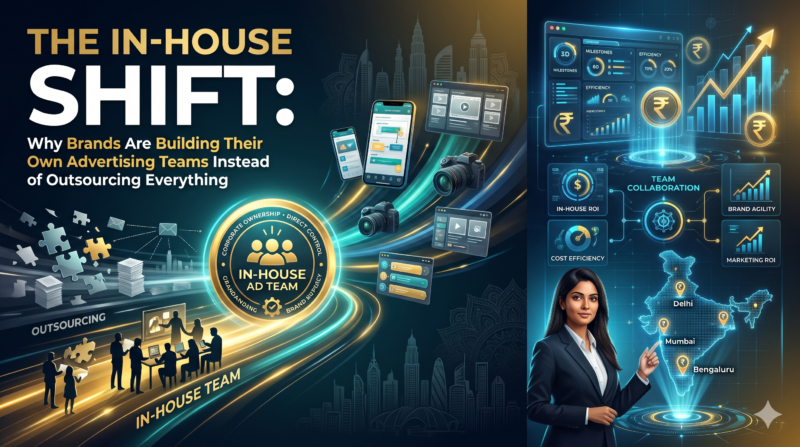
For decades, advertising agencies were the primary partners businesses turned to for campaign ideas, creative production, media planning and brand communication. Today, more companies are developing internal marketing teams to handle a growing share of this work.
The shift is not necessarily about ending relationships with agencies. Instead, brands want greater control over campaign speed, consumer insights, creative consistency and marketing costs.
For Indian businesses competing across e-commerce, social media, quick commerce and traditional media, the ability to produce content quickly and respond to changing customer behaviour has become increasingly valuable.
The result is a new operating model: internal teams handle recurring marketing activities, while external agencies provide specialist expertise, large-scale creative thinking and additional capacity when needed.
The Numbers Behind the Shift
Research from the Association of National Advertisers (ANA) illustrates how established the in-house model has become among its members.
Its 2023 study, The Continued Rise of the In-House Agency, found that 82% of surveyed ANA members had an in-house agency, compared with 78% in 2018, 58% in 2013 and 42% in 2008.
The same research found that 92% of respondents with in-house agencies continued to work with external agencies. Among those using both, an average of 61% of their work was handled internally.
These figures come from ANA members and should not be treated as a direct measurement of the Indian advertising market. However, they demonstrate how brands can expand internal capabilities without abandoning outside partners.
Official source: ANA — The Continued Rise of the In-House Agency.
Why Brands Want More Work In-House
1. Faster Campaign Production
Social media calendars, email campaigns, product listings and performance-advertising creatives often require frequent updates. Internal teams can work closely with product managers and sales teams to respond to new priorities without beginning a new agency briefing process for every task.
This can be especially useful for brands managing multiple products, regional campaigns and frequent promotional events.
2. Stronger Brand Knowledge
Internal employees work closely with the organisation’s products, customers and business objectives. Over time, they can develop a deeper understanding of brand guidelines, customer feedback and previous campaign results.
That institutional knowledge can improve consistency across advertising formats and customer touchpoints.
3. Greater Control Over Marketing Data
Brands increasingly rely on customer information, campaign analytics and performance reporting to guide their decisions.
Keeping certain capabilities in-house can help businesses coordinate data analysis, creative decisions and campaign optimisation more closely. However, internal teams still need appropriate technology, expertise and responsible data-management practices.
4. More Flexible Use of AI
AI tools can help marketing teams produce creative variations, summarise research, adapt content and automate repetitive tasks.
An internal team can incorporate these tools into its existing workflows, provided it maintains human review for accuracy, originality, brand suitability and compliance.
AI can increase production capacity, but it does not remove the need for good ideas or strategic direction.
Why External Agencies Still Matter
Building an internal team requires investment in salaries, software, management, training and production infrastructure. A company that brings every capability in-house may discover that maintaining a full team is more expensive than using external specialists for selected projects.
Agencies can also offer fresh perspectives, specialist talent and the ability to scale resources during major launches.
The World Federation of Advertisers (WFA) has highlighted how brands are experimenting with different content-production arrangements, including internal teams, external agencies and embedded outsourced teams.
Its research indicates that there is no single model suitable for every organisation. The right structure depends on the type of work, market requirements and available capabilities.
Official source: WFA — Research on Changing Content-Production Models.
What This Means for India’s Advertising Industry
For Indian agencies, the shift creates pressure to demonstrate value beyond routine content production. Clients may increasingly expect agencies to deliver specialist strategy, distinctive creative concepts, advanced production, research and measurable business outcomes.
For professionals, it creates additional career opportunities within brand-side marketing departments. Roles in content, creative operations, performance marketing, analytics, design and marketing technology may become increasingly important as companies build internal capabilities.
For smaller businesses, however, a complete in-house agency may not be practical. A lean internal team supported by freelancers, specialist agencies and technology tools can offer a more sustainable alternative.
The Future Is Hybrid
The rise of in-house advertising does not mean agencies are becoming irrelevant. It means brands are reconsidering which activities they should manage themselves and which require external expertise.
Routine, recurring work may be well suited to internal teams, while major brand campaigns, specialist production and complex strategic assignments may benefit from external partners.
The most effective model will depend on business goals, talent, budgets and operational needs.
Ultimately, the competitive advantage will not come from having the largest internal team or the longest agency roster. It will come from organising people, technology and creative expertise in a way that helps the brand move faster, communicate more consistently and produce better business results.