

“Performance branding” has become one of the most frequently used phrases in modern marketing. Indian companies increasingly use the term while discussing campaigns that are expected to build a brand and deliver measurable business results at the same time.
Yet there is no single industry-wide definition of performance branding. The phrase generally describes an approach that combines the long-term objectives of brand marketing with the measurement discipline of performance marketing.
Two Sides of Marketing
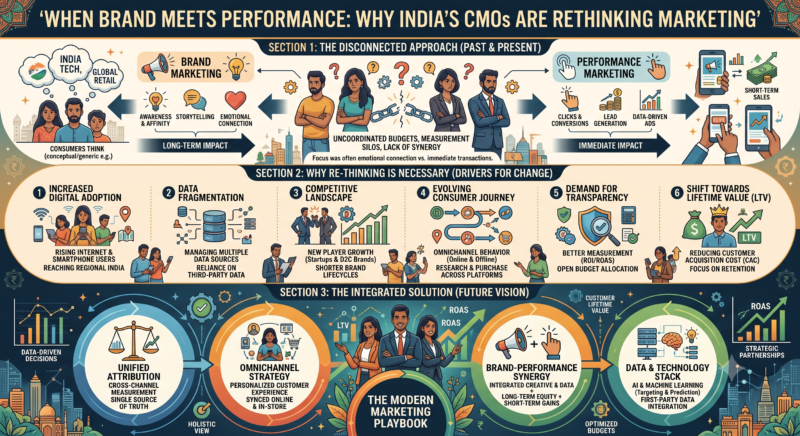
Traditional brand marketing focuses on building awareness, recognition, trust and preference over time.
Performance marketing, meanwhile, is typically built around measurable actions such as clicks, leads, app installations, transactions and customer acquisition.
For years, the two approaches were often managed separately. Brand teams concentrated on long-term perception, while performance teams focused on immediate results.
Performance branding attempts to bring those objectives closer together.
Why The Term Took Off
The rise of digital advertising made measurement a central part of marketing decisions.
CMOs gained access to increasingly detailed information about campaign impressions, clicks, conversions and customer behaviour. At the same time, companies continued to need strong brands that could generate demand beyond individual campaigns.
The result was pressure to demonstrate both immediate commercial impact and longer-term brand value.
Performance branding emerged as a way of describing that middle ground.
Not Just A New Name For Performance Marketing
Performance branding is not necessarily performance marketing with a more attractive label.
A purely performance-driven campaign may optimise heavily for the lowest possible cost per acquisition or the highest conversion rate.
A performance-branding campaign can have additional objectives, such as increasing brand awareness, strengthening brand associations or improving consideration, while still measuring commercial outcomes.
The creative therefore has to work on two levels: attract attention and communicate the brand while also encouraging a measurable response.
The Creative Challenge
One of the biggest challenges is balancing immediate conversion with brand building.
A highly promotional advertisement may generate short-term sales but contribute little to long-term brand distinctiveness.
On the other hand, a memorable brand campaign may create strong awareness without generating an immediately measurable transaction.
Performance branding attempts to bridge the gap.
That can mean creating advertisements that are recognisably branded while incorporating clear calls to action, product benefits or measurable conversion paths.
The Role Of Data
Data is central to the performance side of the equation.
Marketers can examine metrics such as reach, engagement, website visits, leads, conversion rates and customer acquisition costs.
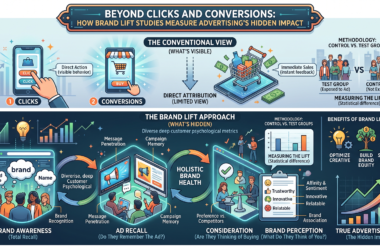
But performance branding also requires broader measures. Brand awareness, consideration, recall and perception can help determine whether advertising is changing how consumers think about a company.
This is where tools such as brand lift studies can complement conventional performance reporting.
Why India Is A Special Case
India’s advertising ecosystem is unusually diverse.
A single consumer may encounter a brand through television, streaming services, social media, search, influencers, outdoor advertising, e-commerce platforms and physical stores.
The same campaign can therefore have different roles at different stages of the consumer journey.
A television advertisement may build awareness, a social-media video may generate consideration and a search advertisement may capture purchase intent.
Performance branding attempts to view these interactions as parts of one marketing system rather than isolated campaigns.
The Attribution Problem
Measuring performance branding is not straightforward.
A consumer may see an advertisement several times before searching for the company independently and eventually making a purchase. Giving the entire conversion to the final search click can understate the contribution of earlier brand-building activity.
At the same time, simply attributing every subsequent purchase to a brand campaign can overstate its impact.
This is why marketers increasingly use multiple measurement methods, including attribution, incrementality testing, marketing mix modelling and brand studies.
CMO Budgets Are Changing
The growing interest in performance branding also reflects a change in how marketing budgets are scrutinised.
CMOs are increasingly expected to connect advertising expenditure with business outcomes while maintaining long-term brand strength.
That does not necessarily mean every rupee spent on brand advertising needs to generate an immediate sale.
Instead, companies are looking for a clearer understanding of how awareness, consideration and conversion interact.
What Performance Branding Really Means
At its core, performance branding is less about a particular advertising format and more about a marketing philosophy.
It asks brands to build distinctive identities while using data to understand what their advertising is achieving.
The approach does not eliminate the traditional divide between brand and performance overnight. Nor does it provide a single metric that captures every aspect of marketing effectiveness.
Instead, it reflects a growing recognition among Indian marketers that consumers do not experience advertising in separate “brand” and “performance” boxes.
They see one brand, across multiple channels and multiple moments.
For CMOs, the challenge is increasingly to measure that entire journey—without sacrificing either the immediate business result or the long-term value of the brand.