

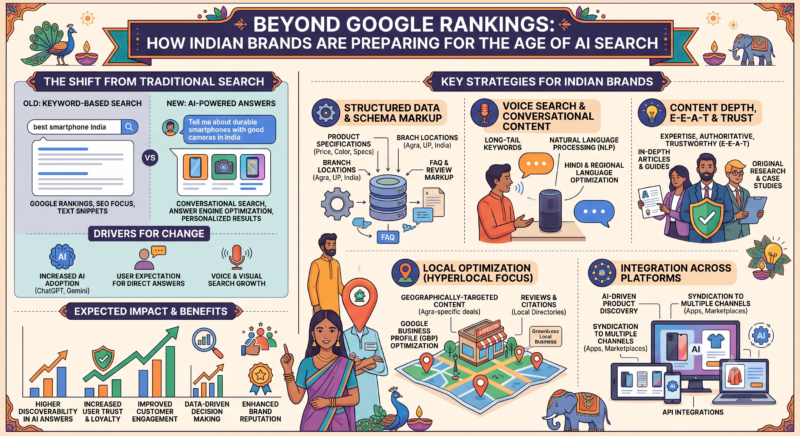
Search is entering a new phase. Instead of typing a few keywords into a search engine and choosing from a list of links, consumers are increasingly asking AI systems complete questions and expecting direct, conversational answers.
That shift is creating a new challenge for marketers: how does a brand become visible when the search result is an AI-generated response rather than a traditional webpage ranking?
The answer is increasingly being discussed as Generative Engine Optimisation, or GEO.
What Is GEO?
GEO refers to the practice of improving a brand’s chances of being accurately mentioned, cited or represented in AI-generated search results.
Traditional SEO focuses heavily on helping webpages rank in search-engine results. GEO looks at a broader environment where AI systems synthesise information from multiple sources to produce an answer.
For brands, the objective is therefore moving beyond simply ranking for keywords. It is increasingly about becoming a credible and useful source of information that AI systems can understand and reference.
Why AI Search Changes Marketing
Traditional search generally presents consumers with multiple links. AI-powered search can instead summarise information and provide a direct response.
That changes the consumer journey.
A person researching smartphones, financial services, hotels, software or healthcare products may ask an AI assistant to compare several options. The resulting answer could influence the consumer before they ever visit a brand’s website.
For marketers, visibility inside that answer can become another form of digital discovery.
SEO Still Matters
GEO does not necessarily replace search-engine optimisation.
Search engines and AI systems still depend heavily on accessible, structured and trustworthy information. Technical website quality, relevant content, clear organisation and authoritative references remain important foundations.
The difference is that GEO places greater emphasis on whether content can be understood and incorporated into an AI-generated answer.
Build Content AI Can Understand
One of the most important changes is the way brands approach content.
Instead of producing pages designed primarily around repeated keywords, marketers are increasingly creating material that directly answers consumer questions.
Clear explanations, definitions, comparisons, original research, product information and expert commentary can give AI systems more useful material to interpret.
Content also benefits from clear headings, concise explanations and structured information.
Authority Becomes More Important
AI-generated answers often rely on information gathered from multiple sources.
That makes a brand’s wider digital reputation important.
Independent publications, industry organisations, credible reviews, research papers and authoritative websites can all contribute to how an organisation is represented online.
For marketers, this means that building authority cannot be limited to publishing content on the company’s own website.
Reviews And Third-Party Mentions
Consumer reviews and third-party discussions can also influence how brands are understood online.
An AI system may encounter information about a company across news articles, review platforms, forums and industry websites.
That creates a challenge for marketers because not every source is under their direct control.
The focus therefore shifts toward maintaining accurate information across important digital touchpoints and responding appropriately when material factual errors appear.
Structured Data Has A Role
Technical optimisation remains part of the picture.
Structured data can help search systems understand information such as products, organisations, events and other entities.
Clear page architecture, consistent company information and crawlable content can make it easier for machines to interpret a website.
These practices are useful for conventional search as well as emerging AI-driven discovery.
The New Brand Metric
Traditional digital marketing has focused on metrics such as rankings, impressions, clicks and conversions.
AI search introduces additional questions.
Is the brand being mentioned when consumers ask relevant questions? Is the information accurate? Which sources are influencing the answer? Is the brand being associated with the right products and attributes?
Marketers are therefore beginning to explore concepts such as AI visibility, brand mentions and citation presence as potential additions to their measurement frameworks.
India’s Opportunity
India’s multilingual and rapidly expanding digital ecosystem creates a particularly interesting environment for AI search.
Consumers increasingly use conversational queries, voice interfaces and digital assistants to discover information. Brands operating across English and Indian languages may eventually need content strategies that account for different ways consumers ask questions.
Local context could also matter, particularly for businesses whose products, services or availability vary across cities and regions.
What Marketers Should Do Now
GEO is still an emerging discipline, and there is no universal formula guaranteeing that an AI system will mention a particular brand.
But the underlying principles are becoming clearer: publish useful information, maintain accurate facts, build credible third-party authority, structure content clearly and make important information accessible to both people and machines.
From Ranking To Being Recommended
The rise of AI search is changing the meaning of digital visibility.
SEO asks whether a brand can appear prominently among search results. GEO asks a broader question: when an AI system answers a consumer’s question, is the brand part of the information it considers relevant and trustworthy?
For Indian marketers, that represents a significant change in the search landscape. The competition may increasingly be not just for the top position on a results page, but for a place inside the answer itself.