


Influencer marketing has become a major part of India’s digital advertising industry, but the growth of creator-led campaigns has also created a basic compliance question: when does a social-media recommendation become an advertisement?
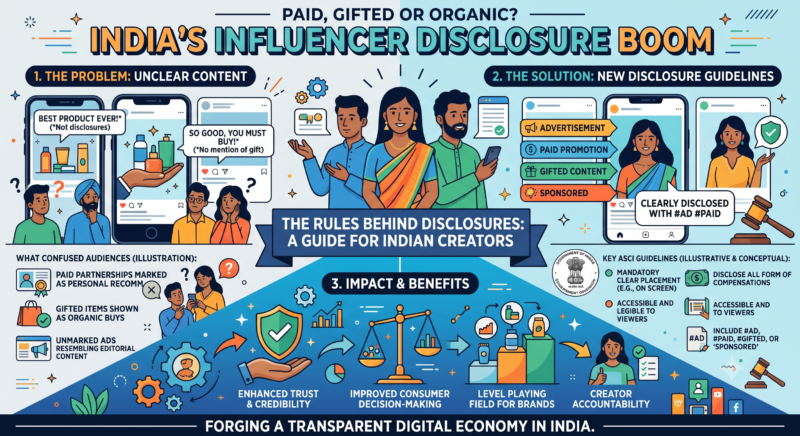
The Advertising Standards Council of India (ASCI) has established guidelines requiring influencers to clearly disclose material connections with brands. The objective is to ensure consumers can distinguish paid or commercial communication from independent content.
What Counts as a Material Connection?
A disclosure is generally required when an influencer has a material connection with a brand that could affect how consumers interpret the content.
This can include monetary compensation, free products, gifts, discounts, trips, hotel stays, services or other benefits.
The important point is that payment is not the only trigger. An influencer can have a disclosure obligation even when no cash changes hands.
Why Disclosure Matters
Influencer content often looks different from conventional advertising.
A television commercial is clearly recognisable as advertising. A creator talking about a product in a personal video, however, can appear to be an ordinary recommendation.
Disclosure rules are intended to make the commercial relationship visible before consumers evaluate the recommendation.
The principle is straightforward: consumers should know when there is a commercial connection.
Where Should The Disclosure Appear?
The disclosure should be prominent and easy to notice.
For social-media posts, it should not be buried among hashtags, placed somewhere consumers are unlikely to see or hidden behind an additional click.
The disclosure should also be understandable to the audience.
ASCI’s guidelines recognise labels such as #Ad, #Sponsored, #Collaboration, #Partnership and other clearly understood terms, subject to the requirements of the relevant format.
Video Creates Extra Rules
Video content can create a different compliance challenge because viewers may not read the caption.
For videos, the disclosure should be presented in a way that is visible and understandable to viewers. Where appropriate, it may need to remain on screen long enough to be noticed.
For livestreams, disclosures need to be repeated periodically so viewers who join later can also understand the commercial relationship.
Stories And Short-Form Content
Temporary formats such as Instagram Stories and similar short-form content require particular attention.
A disclosure that appears only briefly or is hidden among other elements may not be sufficient.
Because audiences can consume individual frames without seeing the surrounding campaign, each relevant piece of content needs to communicate its advertising nature clearly.
Virtual Influencers Are Included
The influencer economy is also expanding beyond human creators.
Virtual influencers and digitally generated personalities can participate in commercial campaigns, creating similar transparency concerns.
The central issue remains the same: consumers should not be misled about the commercial nature of content simply because the creator is digitally generated.
When No Disclosure May Be Needed
Not every mention of a brand automatically becomes an advertisement.
If a creator independently purchases a product and discusses it without receiving a material benefit or having a commercial relationship with the brand, an advertising disclosure may not necessarily be required.
However, the circumstances surrounding the content matter.
A free product, payment, affiliate relationship or other benefit can change the nature of the communication.
Responsibility Is Shared
Influencer compliance is not only the creator’s responsibility.
Advertisers and agencies also play an important role in ensuring that commercial communications are properly disclosed.
Brands commissioning campaigns should communicate disclosure requirements clearly, while influencers need to understand what benefits or relationships trigger disclosure obligations.
What Can Go Wrong?
A violation can occur when an influencer fails to disclose a material connection, uses an unclear label or places the disclosure where consumers are unlikely to notice it.
Problems can also arise when a creator describes sponsored content as an independent personal recommendation without making the commercial relationship clear.
The issue is therefore not simply whether the word “advertisement” appears somewhere. The disclosure must be sufficiently clear for an ordinary consumer to understand the nature of the relationship.
The Rules Are Becoming More Important
India’s influencer economy is becoming increasingly sophisticated. Brands now work with celebrities, professional creators, niche experts, micro-influencers and everyday users across multiple platforms.
As commercial content becomes harder to distinguish from ordinary social-media conversations, disclosure has become a central part of advertising compliance.
Transparency Becomes The Brand Standard
Influencer marketing works partly because audiences trust creators to make personal recommendations. That trust makes transparency particularly important.
For marketers, the safest approach is to treat disclosure as part of the campaign design rather than something added after the content has been produced.
For creators, understanding when and how to disclose a commercial relationship is increasingly part of professional influencer practice.
The broader shift is clear: in India’s creator economy, transparency is no longer just a disclosure requirement—it is becoming part of how responsible digital advertising is expected to work.