




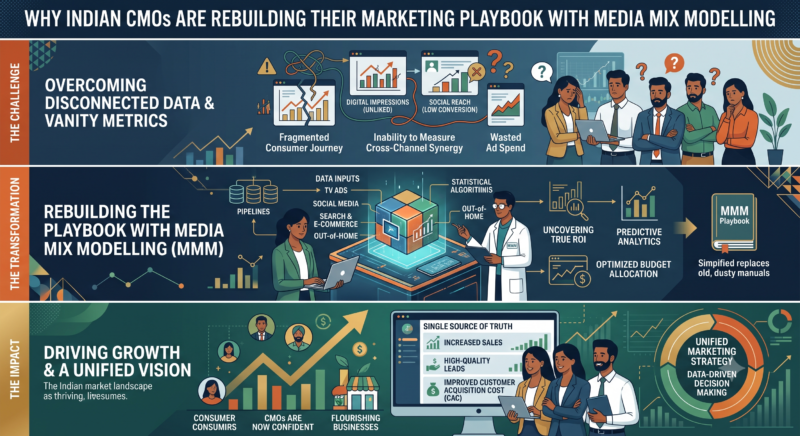
Media Mix Modelling (MMM) is making a strong comeback in the marketing world as Indian companies look for more reliable ways to understand where their advertising budgets are actually generating business results.
For years, marketers increasingly relied on digital dashboards, platform-level attribution and real-time campaign metrics. But as privacy restrictions, fragmented media consumption and questions around attribution have grown, MMM has returned as an important strategic tool.
What Is MMM?
Media Mix Modelling is a statistical approach used to estimate how different marketing channels contribute to business outcomes such as sales, revenue or market share.
Instead of examining a single customer journey, MMM looks at historical data across multiple channels and factors. Television, digital advertising, social media, print, outdoor advertising, promotions and other marketing activities can be analysed alongside sales and broader business variables.
The objective is to understand the relationship between marketing investment and business performance.
Why The Old Model Lost Ground
MMM is not new. Large advertisers have used variations of the methodology for decades.
However, the rapid growth of digital advertising changed the way marketing effectiveness was measured. Platforms could provide detailed information about impressions, clicks, conversions and customer journeys.
These metrics appeared to offer marketers a faster and more granular view of campaign performance than traditional modelling.
But platform-level measurement has an inherent limitation: each advertising platform generally measures performance within its own ecosystem.
A brand running campaigns across several platforms may therefore receive different versions of the truth.
Privacy Changes The Equation
The digital advertising environment has also become more complicated.
Changes to cookies, mobile identifiers and privacy rules have reduced the amount of user-level information available to marketers. Consumers increasingly expect greater control over how their data is collected and used.
MMM does not depend on tracking every individual consumer. Instead, it can work with aggregated historical data.
That has made the methodology increasingly relevant for companies seeking measurement approaches that are less dependent on individual-level tracking.
India Adds More Complexity
India’s advertising market is particularly diverse.
Brands can reach consumers through television, newspapers, radio, outdoor advertising, social media, search, e-commerce platforms, influencers, streaming services and quick-commerce apps.
Consumer behaviour can also vary substantially between cities, regions and demographic groups.
For CMOs managing large and increasingly fragmented marketing budgets, understanding how these channels interact has become more important.
MMM can help companies examine these investments collectively rather than evaluating every channel in isolation.
Beyond Clicks And Impressions
One of the biggest attractions of MMM is its focus on business outcomes.
A campaign may generate millions of impressions without immediately producing measurable online conversions. Conversely, a channel that appears highly efficient through last-click attribution may have benefited from awareness created elsewhere.
MMM attempts to account for these broader relationships.
It can also incorporate factors such as seasonality, pricing, promotions, economic conditions and distribution changes, depending on the model and data available.
The Rise Of Modern MMM
Today’s MMM is different from many traditional models.
Advances in computing, data infrastructure and statistical techniques have made it possible to build models more quickly and update them more frequently.
Companies can combine sales information with advertising expenditure, media activity and other commercial variables to create increasingly sophisticated measurement systems.
Artificial intelligence and machine-learning techniques are also being explored alongside traditional statistical approaches, although model quality ultimately depends on the quality and structure of the underlying data.
A Tool, Not A Magic Formula
MMM also has limitations.
The methodology depends heavily on historical data and appropriate modelling assumptions. Poor-quality data, insufficient observations or rapidly changing market conditions can reduce the usefulness of the results.
It can also be difficult to isolate the impact of channels that operate simultaneously.
For that reason, marketers generally need to treat MMM as one component of a broader measurement framework rather than a replacement for every other form of analysis.
Why CMOs Are Looking Again
The renewed interest in MMM reflects a larger change in marketing.
CMOs increasingly need to demonstrate not simply that campaigns generated clicks or engagement, but how marketing investment contributed to revenue and long-term business growth.
In India’s increasingly fragmented media environment, that question is becoming harder to answer through individual platform reports alone.
MMM offers a way to step back, examine the entire marketing ecosystem and connect advertising investment with broader business performance.
The Road Ahead
As India’s advertising landscape becomes more complex, marketing measurement is likely to become as important as media buying itself.
Media Mix Modelling cannot eliminate uncertainty, but it can give businesses another framework for understanding how different investments work together.
For Indian CMOs, its return represents less a rejection of digital measurement than an attempt to build a more complete picture one that connects advertising activity with the business results that ultimately matter.