



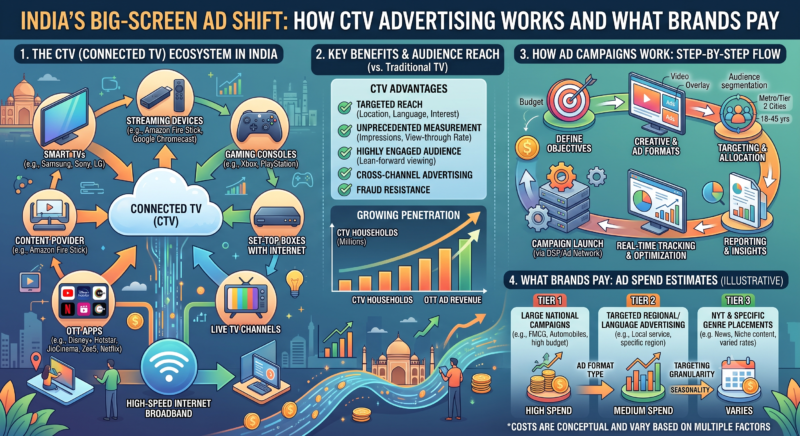
Connected TV, or CTV, is changing the way Indian advertisers approach television. As more households use smart TVs and streaming devices to consume digital content, brands can increasingly combine the reach of television with the targeting capabilities of digital advertising.
CTV advertising refers to advertisements delivered through internet-connected televisions, including smart TVs and streaming devices. Unlike traditional linear television, CTV can use audience and viewing information to help advertisers target specific households or consumer groups.
What Exactly Is CTV?
CTV is essentially the intersection of television and the internet.
A viewer watching content through an OTT application on a smart TV may see a pre-roll, mid-roll, or other digital advertisement. The same campaign can potentially be targeted according to factors such as geography, audience characteristics, device, and content environment.
Government-backed industry research noted that Indian CTV advertising expenditure increased from about ₹450 crore in 2022 to ₹1,500 crore in 2024, while CTV accounted for about 1.5% of India’s digital advertising market at the time.
How a CTV Campaign Works
The process resembles digital advertising more than conventional television buying.
Advertisers first define their audience, geography, and campaign objective. Media planners then select platforms, content environments, and inventory that fit those requirements.
The advertisement is subsequently delivered to eligible viewers while they watch streaming content on connected television devices.
Depending on the platform and buying arrangement, campaigns can be purchased directly from publishers, through private marketplace deals, or programmatically.
Where the Money Goes
CTV pricing in India varies considerably.
Indicative industry benchmarks put many CTV campaigns in the range of roughly ₹150 to ₹800 per thousand impressions, while premium sports and high-demand inventory can cost substantially more. These figures are benchmarks rather than fixed rate cards, and actual prices depend on the platform, audience, season, and deal structure.
Campaign budgets can range from relatively small regional tests to multi-crore national campaigns.
The CPM Model
One of the most common ways to understand CTV pricing is CPM, or cost per thousand impressions.
If a campaign has a ₹400 CPM, for example, an advertiser would pay approximately ₹400 for every 1,000 measured impressions, before any applicable technology, agency, or other fees.
Premium targeting and highly sought-after content can push the CPM higher.
Sports Changes Everything
Live sports represent one of the most expensive areas of CTV advertising.
During the IPL, for example, connected-TV inventory has commanded significant premiums. Industry reports said CTV advertising rates during IPL 2025 increased by around 10–20%, with some 10-second spot buys reported at approximately ₹8.5 lakh.
For IPL 2026, industry reporting indicated that CTV pricing had moved higher, with a benchmark of roughly ₹600 CPM on JioStar’s rate card, while premium inventory could command considerably more depending on the package.
Why Brands Pay More
CTV offers something traditional television cannot easily provide: a combination of large-screen viewing and digital targeting.
Advertisers can potentially focus campaigns by geography, audience characteristics, and content preferences rather than purchasing a broad television audience alone.
This can reduce some of the wastage associated with mass-market advertising, particularly for brands with clearly defined target audiences.
More Than Video Ads
CTV advertising is not limited to conventional 10- or 20-second commercials.
Formats can include pre-roll and mid-roll video, home-screen placements, pause advertisements, interactive formats, and other connected-TV experiences.
The choice of format can significantly affect campaign costs and the type of consumer interaction available.
Measurement Is Still A Challenge
One of CTV’s biggest advantages is also one of its biggest challenges: measurement.
Different platforms can use different definitions of an impression, audience, and completed view. Advertisers therefore need to understand exactly what is being measured before comparing campaigns across publishers.
Cross-platform duplication can also make it difficult to determine how many unique households were actually reached.
India’s broader television measurement environment has faced additional disruption in 2026, with BARC’s television ratings system experiencing a prolonged ratings blackout. Industry bodies have highlighted the impact on advertising planning and measurement.
CTV Versus Traditional TV
Traditional television remains powerful because of its scale and established audience measurement ecosystem. CTV, meanwhile, offers greater flexibility in targeting and digital-style measurement.
The two formats are increasingly being viewed as complementary rather than mutually exclusive.
A brand can use traditional television to build mass awareness while using CTV to reach specific audience segments or extend campaigns across streaming environments.
What Should Advertisers Budget?
There is no single CTV price in India.
Small test campaigns can begin with comparatively modest budgets, while regional campaigns can require several lakh rupees and large national campaigns can run into tens of lakhs or more. Premium sports packages can reach significantly higher levels.
The final cost depends on audience size, platform, geography, inventory, duration, targeting, seasonality, and the buying method.
The Next Television Ad Market
CTV is still a relatively young advertising channel in India, but its growth reflects a larger change in how Indians consume video.
As smart-TV ownership and streaming continue to expand, advertisers are gaining another way to combine television’s large-screen impact with digital targeting.
For marketers, the key question is no longer simply whether CTV is cheaper or more expensive than television. It is whether the additional targeting, measurement, and incremental reach justify the premium paid for the particular audience and campaign objective.