

India’s advertising industry has developed a vocabulary of its own as traditional media, digital platforms, e-commerce, influencers, streaming services and artificial intelligence increasingly converge. For new marketers, founders and business leaders, understanding the terminology can be almost as important as understanding the campaigns themselves.
From familiar measurements such as CPM and CTR to newer concepts such as retail media, GEO and connected-TV advertising, these terms describe how advertisements are created, purchased, delivered and measured.
The Buying Basics
At the centre of advertising is the advertiser—the company or organisation paying to promote a product, service or message.
An agency develops strategy, creative work, media plans or campaign execution on behalf of advertisers. A media agency specifically focuses on planning and purchasing advertising space.
Media buying is the process of purchasing advertising inventory, while media planning determines where and when advertising should appear.
Inventory refers to available advertising space or opportunities.
The Numbers Behind Ads
Impressions measure the number of times an advertisement is displayed.
Reach measures the number of individual people or households exposed to an advertisement.
Frequency indicates how many times, on average, someone is exposed to a campaign.
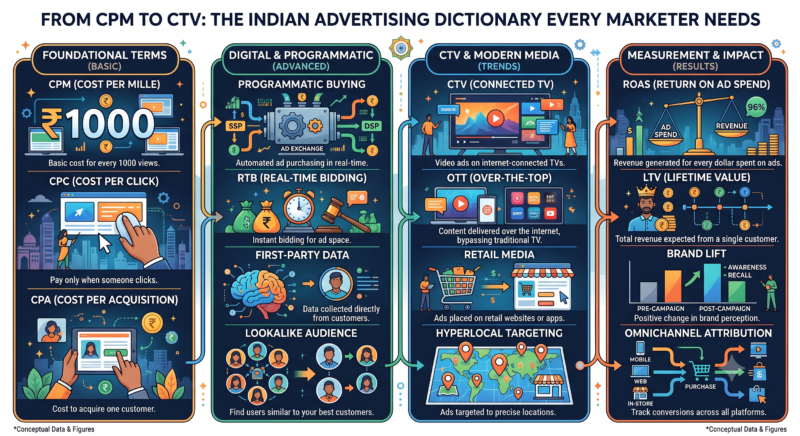
CPM, or cost per thousand impressions, measures the price of reaching 1,000 impressions.
CPC means cost per click, while CPA means cost per acquisition or action.
CTR, or click-through rate, measures the percentage of impressions that result in clicks.
Conversion rate measures the proportion of users completing a desired action.
Digital Advertising Terms
Programmatic advertising uses automated technology to buy and sell digital advertising inventory.
A DSP, or demand-side platform, helps advertisers purchase digital inventory.
An SSP, or supply-side platform, helps publishers sell their advertising inventory.
An ad exchange facilitates transactions between buyers and sellers.
Retargeting allows advertisers to reach users who have previously interacted with a brand or website.
Performance marketing focuses heavily on measurable actions such as leads, sales or installations.
Brand Building
Brand awareness measures whether consumers know or recognise a brand.
Brand recall examines whether consumers remember a brand or advertisement.
Brand consideration measures whether consumers would consider purchasing from a brand.
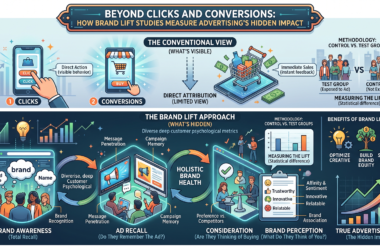
Brand lift measures changes in consumer awareness, perception or consideration following advertising exposure.
Performance branding combines long-term brand-building objectives with measurable performance outcomes.
Television And Video
Linear TV refers to scheduled television programming.
CTV, or connected TV, refers to television viewing through internet-connected devices.
OTT, or over-the-top media, describes video and other content delivered through internet-based services rather than traditional broadcasting systems.
Pre-roll advertisements appear before video content.
Mid-roll advertisements appear during video content.
Post-roll advertisements appear after video content.
The New Retail Media Economy
Retail media refers to advertising opportunities provided by retailers and commerce platforms.
Sponsored products are paid product placements within shopping platforms.
Retail media networks combine advertising inventory and consumer data owned or controlled by retailers.
Commerce media is a broader concept covering advertising connected to commerce and purchasing environments.
Influencer Marketing
An influencer is a creator or public personality who can affect audience perceptions or purchasing decisions.
Creator marketing involves brands working with digital content creators.
Sponsored content is content created as part of a commercial arrangement.
Influencer disclosure tells audiences when a creator has a material commercial relationship with a brand.
Affiliate marketing rewards partners or creators for generating measurable sales or actions.
Measurement And Attribution
Attribution attempts to determine which marketing touchpoints contributed to a conversion.
Last-click attribution assigns credit primarily to the final measurable click before conversion.
Multi-touch attribution distributes credit across multiple consumer touchpoints.
MMM, or Media Mix Modelling, uses statistical analysis to estimate how different marketing channels contribute to business outcomes.
Incrementality examines whether a marketing activity generated results that would not otherwise have occurred.
Creative And Messaging
A creative is the advertisement itself, including its visual, audio and written elements.
A CTA, or call to action, tells consumers what to do next.
A copywriter develops advertising text, while an art director oversees visual direction.
A brand proposition communicates the central value a brand promises to consumers.
Compliance And Consumer Protection
Surrogate advertising involves communication that may indirectly promote a product whose direct advertising is restricted.
Dark patterns are digital design practices that can manipulate or mislead consumers.
Disclaimers provide important qualifying information about an advertising claim or offer.
ASCI, the Advertising Standards Council of India, operates India’s advertising self-regulatory framework.
The CCPA, or Central Consumer Protection Authority, is the government authority responsible for enforcing consumer-protection legislation and related rules.
Where Advertising Is Heading
The Indian advertising vocabulary continues to expand as technology changes how consumers discover and purchase products.
Artificial intelligence, connected television, retail media, creator marketing and AI-powered search are creating new terminology alongside traditional concepts that have existed for decades.
For marketers, knowing the language is more than an exercise in terminology. Understanding what CPM, CTR, MMM, CTV, DSP, SSP, brand lift and incrementality actually measure helps businesses ask better questions about where their advertising money goes—and what it ultimately delivers.
The advertising industry may continue inventing new terms, but the underlying objective remains familiar: put the right message in front of the right audience and understand what happens next.