




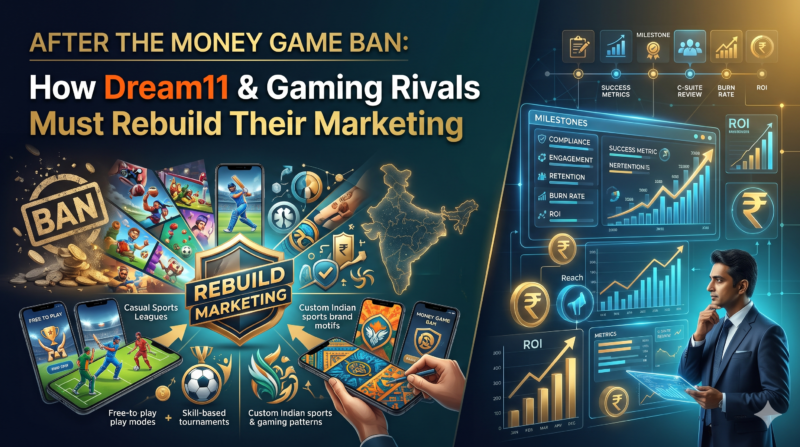
India’s online gaming crackdown has changed the business of player acquisition. Sports content, free-to-play experiences and digital communities are emerging as important alternatives to cash-contest promotion.
1. A New Rulebook for Gaming Brands
For years, real-money gaming platforms built their marketing around cricket tournaments, celebrity endorsements, fantasy team selection and the possibility of winning cash prizes. The formula connected sports fandom with a competitive digital experience.
That model has fundamentally changed.
The Promotion and Regulation of Online Gaming Act, 2025 prohibits online money games and their advertising, promotion and facilitation. The government’s accompanying rules took effect on 1 May 2026, establishing a framework for distinguishing prohibited money games from permissible online social games and esports.
The penalties can be significant. The government states that advertising prohibited online money games can attract imprisonment of up to two years, a fine of up to ₹50 lakh, or both for a first conviction. The official legislation sets out the prohibitions, while the government’s explanation of the 2026 rules outlines the new regulatory structure.
For marketers, this is not merely a change in advertising language. It changes which products can be promoted and how gaming companies can build their businesses.
2. Dream11: From Cash Contests to Sports Engagement
Dream11 built a recognisable brand by encouraging fans to assemble fantasy teams around real sporting events. Its marketing connected player knowledge, match-day excitement and competition.
Its current public-facing terms reflect a different emphasis. Dream11 describes its platform as a place for sports-related content, community engagement, free-to-play fantasy sports and permitted online social games.
The company’s official terms and conditions also state that its leagues in India are free to play and prohibit users from promoting contests that require stakes in expectation of monetary winnings.
This creates a different marketing proposition. Rather than making cash prizes the central attraction, a platform can focus on match analysis, team selection, player statistics, sports discussions and participation for entertainment.
The challenge is retention. A free experience must give fans reasons to return even when there is no financial reward attached to the result.
3. MPL: Entertainment Without Cash Games
Mobile Premier League, commonly known as MPL, illustrates another possible direction.
Its official website states that deposits are no longer available and that cash games are unavailable in compliance with the law.
The shift changes the product story. Instead of presenting the platform around monetary rewards, marketing can emphasise game variety, skill development, friendly competition and entertainment, provided the advertised products comply with applicable law.
For a gaming company, this also means reassessing customer acquisition costs. A campaign designed to attract users interested primarily in cash winnings may not translate into an audience willing to play for entertainment alone.
The new challenge is to attract users who value the game itself.
4. The Marketing Playbook Is Changing
Three areas could become increasingly important for platforms offering permitted experiences.
Sports content and fandom: Match previews, statistics, player stories, interactive polls and fan conversations can help brands stay relevant between major sporting events. Content must remain separate from promotion of prohibited money games.
Free-to-play experiences: Free contests and social gaming can provide ways for users to participate without staking money for monetary winnings. Strong design, fair competition and repeat engagement become central to the value proposition.
Community-led engagement: Features such as leaderboards, discussion spaces, creator content and friendly challenges can encourage participation. Any associated advertising or product design must still comply with gaming law.
These approaches are not loopholes. A free game or sports-themed campaign cannot automatically be treated as lawful if it directly or indirectly advertises or facilitates a prohibited money game.
5. What Happens to Celebrity Advertising?
Celebrity endorsements and sports sponsorships have historically helped gaming brands achieve national visibility. Under the new framework, marketers must evaluate not only the celebrity or sponsorship agreement but also the product being promoted and the message delivered.
An advertisement that promotes a prohibited money game cannot be made permissible simply by presenting it as entertainment or attaching a responsible-use disclaimer.
Companies and advertising partners therefore need stronger legal review, clearer product distinctions and careful assessment of campaign creatives, digital links and calls to action.
The government’s official announcement of the Gaming Act specifically confirms that the prohibition extends to advertising and promotion.
6. The New Competition: Attention, Not Winnings
The ban forces gaming marketers to rethink a fundamental question: why should someone open an app when the promise of monetary winnings is no longer available?
The answer may lie in better gameplay, more useful sports content, stronger communities and experiences that make participation enjoyable on their own.
Dream11 and MPL’s public-facing platforms show how companies are adapting their product messaging to a landscape where free-to-play and permitted social experiences take greater prominence.
The larger lesson for the industry is clear. The next generation of gaming brands will need to sell the experience, not the expectation of cash rewards. In India’s new regulatory environment, sustainable marketing begins with a lawful product and builds loyalty around the value it delivers.