





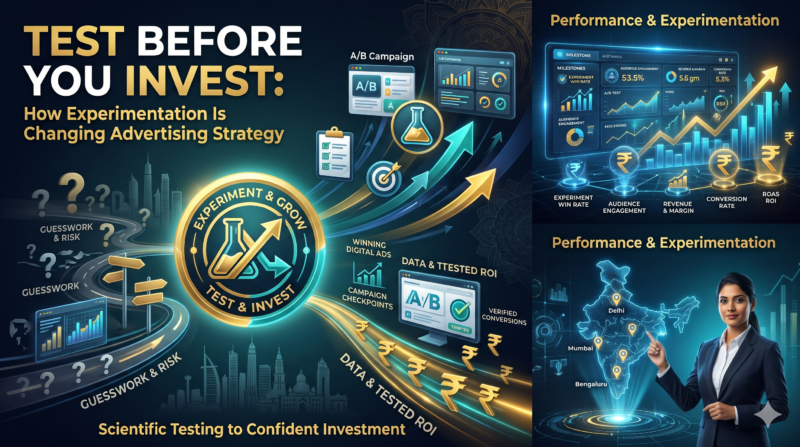
The End of Marketing Guesswork
Why does one advertisement generate sales while another struggles to attract attention? Is a discount more persuasive than free delivery? Does a customer respond better to a product demonstration or an emotional story?
For marketing teams, these questions can no longer be answered by instinct alone. Advertising experimentation is giving businesses a structured way to compare ideas, understand customer behaviour and make more informed investment decisions.
Instead of committing an entire budget to a single creative approach, brands can test different versions, analyse the results and use the findings to improve future campaigns.
The principle is simple: replace assumptions with evidence.
What Is Advertising Experimentation?
Advertising experimentation involves testing different campaign elements to determine which approach performs better against a defined objective.
One common method is A/B testing, in which audiences are shown two versions of an advertisement, landing page or campaign element. Marketers then compare their performance using predetermined metrics.
Google explains this approach through its official Google Ads Experiments guidance, which describes how advertisers can compare proposed campaign changes with existing campaigns before deciding whether to implement them.
Experiments can examine creative formats, headlines, calls to action, bidding strategies, audience approaches and landing pages. The right choice depends on the campaign’s purpose and the question the marketing team wants to answer.
Small Changes Can Reveal Big Insights
Consider an Indian online education company promoting a professional course.
Its marketing team creates two advertisements. The first highlights career advancement, while the second emphasises flexible learning and convenience.
Rather than choosing the version that looks more attractive internally, the company tests both with comparable audience groups. It evaluates not only clicks but also registrations, qualified enquiries and eventual enrolments.
The results may reveal that one advertisement attracts more visitors while the other generates more serious prospects.
This distinction matters because the most popular advertisement is not necessarily the most profitable.
Similar experiments can help consumer brands test product photography, financial services companies evaluate calls to action and travel businesses compare destination-led messaging with price-focused promotions.
Give Every Experiment a Clear Objective
A successful experiment starts with a specific question.
A brand might ask whether changing its headline increases qualified leads or whether a simplified landing page improves completed registrations.
The team should identify the primary metric before the test begins. It should also decide which other indicators matter, how much traffic the experiment requires and how long the test should run.
Changing several major elements simultaneously can make results difficult to interpret. If a team changes the headline, audience, budget and landing page together, it may struggle to determine which change influenced performance.
A controlled experiment isolates the variables as far as practical, allowing marketers to draw more useful conclusions.
The Role of Technology
Advertising platforms are making structured testing easier to manage. Google Ads provides campaign experiments, while Meta’s advertising education resources cover A/B tests, creative testing and conversion-lift studies.
Meta Blueprint’s official course on A/B tests and lift studies explains how advertisers can design experiments, evaluate results and interpret whether findings are conclusive.
These tools can support better decisions, but technology does not eliminate the need for sound research. A poorly designed experiment can still produce misleading conclusions, even when the reporting dashboard looks sophisticated.
Avoid the Common Testing Traps
One of the biggest mistakes is ending an experiment too early. A temporary increase in clicks may reflect random variation rather than a genuine improvement.
Testing too many variables at once, comparing audiences with different characteristics or changing budgets midway through a test can also weaken the results.
Google’s official guidance on experiment reporting discusses confidence levels, experiment duration and other considerations for interpreting results.
Marketers should also avoid selecting a winner based on a secondary metric when the campaign’s actual goal is sales or qualified leads.
If the evidence is inconclusive, the correct response may be to continue testing, refine the hypothesis or acknowledge that neither version has demonstrated a meaningful advantage.
Turn Learning Into a Competitive Advantage
Experimentation becomes valuable when its lessons influence future decisions.
Marketing teams should document what they tested, why they tested it, which metrics they used and what the results revealed. Over time, these findings can help businesses understand which messages resonate with different audiences and which campaign approaches deserve further investment.
The aim is not to test every minor detail indefinitely. It is to prioritise experiments that can meaningfully improve business outcomes.
For Indian brands operating under competitive budgets, disciplined experimentation offers a practical way to reduce avoidable guesswork.
The future of advertising will still depend on creativity, strategic thinking and an understanding of people. But the strongest campaigns will increasingly combine those qualities with a willingness to test ideas, learn from evidence and improve continuously.