





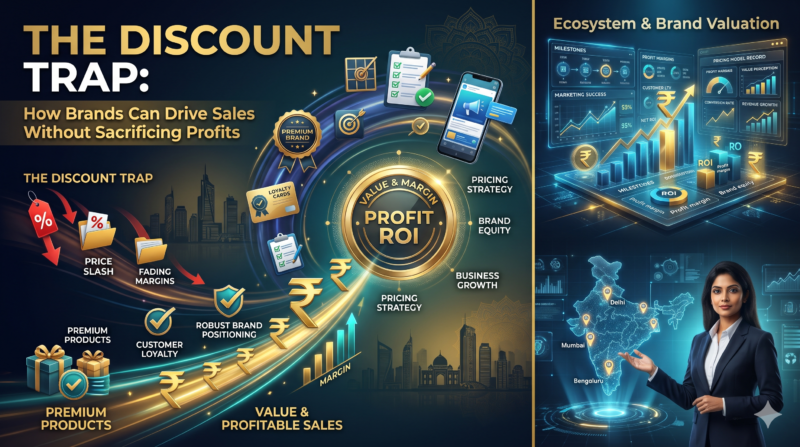
When Every Sale Comes at a Cost
Discounts have become a familiar feature of modern marketing. From festive shopping events and end-of-season sales to app-exclusive offers and limited-time coupons, brands regularly reduce prices to attract customers and encourage purchases.
The strategy can work. A compelling offer may persuade hesitant shoppers to buy, encourage customers to try a new product or help retailers clear excess inventory. But discounts can also create an expensive problem: higher sales do not always translate into higher profits.
For marketing teams, the challenge is no longer simply how to create an attractive offer. It is how to make promotions profitable, preserve brand value and give customers a reason to return even when products are sold at their regular prices.
India’s Growing Focus on Value
Indian consumers are increasingly attentive to the relationship between price, quality and perceived value. For businesses, this makes promotional strategy an important part of customer acquisition and retention.
In its May 2026 report, NielsenIQ’s analysis of pricing and promotion trends in India examines how price sensitivity, promotional effectiveness and product-pack structures are influencing the fast-moving consumer goods market.
The research highlights a significant challenge for marketers: promotions do not automatically create additional value. A campaign may generate transactions without producing enough incremental demand to justify the discount.
This distinction matters in competitive categories where customers can compare prices across retailers, marketplaces and competing brands within seconds.
The Hidden Mathematics of Discounts
Consider a product that sells for ₹1,000 and generates ₹300 in contribution before marketing costs. If a brand offers a 20% discount, the selling price falls to ₹800.
Assuming the cost of supplying the product remains unchanged, the contribution falls from ₹300 to ₹100.
The company must now sell three times as many units to generate the same total contribution as before, assuming all other factors remain constant.
This simplified example demonstrates why a discount that appears modest to a shopper can have a substantial effect on business economics.
Marketing teams should therefore evaluate offers using contribution margins, fulfilment expenses, advertising costs and other relevant variables rather than measuring success through sales volume alone.
Not Every Customer Needs a Discount
One common mistake is offering the same promotion to every customer, regardless of their purchase intentions.
Some shoppers may need an incentive to try a product for the first time. Others may already be loyal customers who would have purchased it at full price.
Discounting to the second group can reduce profitability without generating additional demand.
A more targeted approach considers customer behaviour, purchase frequency, product category and the objective of the campaign. New-customer offers, carefully designed bundles and loyalty rewards can serve different purposes without requiring a blanket price reduction.
However, personalisation should be transparent and respectful of customer privacy. Businesses should avoid using sensitive personal information to determine promotional eligibility.
Why Constant Sales Can Weaken a Brand
Frequent discounts can gradually change how customers perceive a product.
When shoppers repeatedly encounter the same item at a reduced price, they may begin to question its regular price or delay purchases until the next promotion.
This behaviour can make demand increasingly dependent on discounts. Marketing teams then face pressure to offer larger reductions to achieve results that previously required smaller incentives.
Research discussed by Harvard Business Review in Who Benefits from Price Promotions? highlights how the sales effects of promotions can be temporary, with purchasing behaviour returning towards normal once offers end.
For brands seeking long-term growth, promotions should complement a clear value proposition rather than replace it.
Product quality, customer service, convenience, reliability and differentiation can all help justify a product’s regular price.
Smarter Alternatives to Blanket Discounts
Businesses do not need to eliminate promotions to protect their margins. They need to select the right incentive for the right objective.
Product bundles: Combining complementary products can increase the value of an order while allowing businesses to manage the overall economics of the offer.
Loyalty rewards: Points, member benefits and repeat-purchase incentives can encourage retention without automatically lowering every product’s price.
Value-added offers: Free delivery above a qualifying order value, useful accessories or complimentary services may provide an attractive benefit without reducing the headline product price.
Targeted promotions: Limited offers for specific customer groups or product categories can help brands focus spending where it has the greatest potential to generate additional demand.
Pack-size choices: Different product sizes and price points can make products accessible to different budgets. Marketers should ensure that unit pricing and product information remain clear.
The most suitable approach depends on the product, audience, competitive environment and cost structure.
Measure Incremental Growth, Not Just Revenue
A promotion should be judged against what would probably have happened without it.
If a brand generates 1,000 sales during a campaign, the important question is how many of those purchases were genuinely additional. Some customers may have bought anyway, while others may simply have shifted their purchases from a later date.
Marketers should compare promotional performance with a suitable baseline and examine incremental sales, contribution profit, repeat purchases and customer retention.
They should also monitor what happens after the promotion ends. A campaign that produces a short-term sales spike but weakens subsequent demand may deliver less value than its initial results suggest.
Controlled tests, historical comparisons and category-level analysis can help businesses evaluate these effects more accurately.
From Discount Culture to Value Creation
Discounts will remain an important part of India’s marketing landscape, particularly during competitive shopping periods and product launches. The opportunity lies in making them more deliberate.
Brands that understand customer price sensitivity, calculate promotional profitability and distinguish incremental demand from existing demand can make better decisions about when to reduce prices and when to communicate value in other ways.
The strongest promotional strategy is not necessarily the one offering the biggest discount. It is the one that gives customers a compelling reason to buy while allowing the business to grow sustainably.
In a market where everyone can offer a deal, profitable growth depends on knowing which deals are actually worth making.