

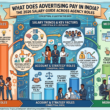

India’s advertising industry is changing quickly, and so is the pay structure behind it. Agencies are hiring across creative, media, digital, strategy, performance marketing, data, technology and client servicing, while experienced professionals with specialised skills are increasingly moving into higher-paying roles.
There is no single standard salary scale for the industry. Pay varies substantially by agency network, city, experience, portfolio, client responsibilities and specialist expertise. The figures below should therefore be treated as indicative 2026 market ranges rather than fixed industry rates.
Freshers Start Differently
Entry-level salaries in advertising remain relatively modest compared with technology and investment banking.
A junior copywriter, visual designer, account executive or media executive can typically expect around ₹3 lakh to ₹6 lakh a year, depending on the agency and location.
Candidates entering specialised digital, analytics or performance-marketing roles may command higher starting packages when they have relevant technical skills.
Mumbai, Delhi-NCR and Bengaluru generally offer a larger concentration of opportunities, although agencies and digital firms operate across other Indian cities as well.
Copywriters And Art Directors
Creative remains one of advertising’s most recognisable career paths.
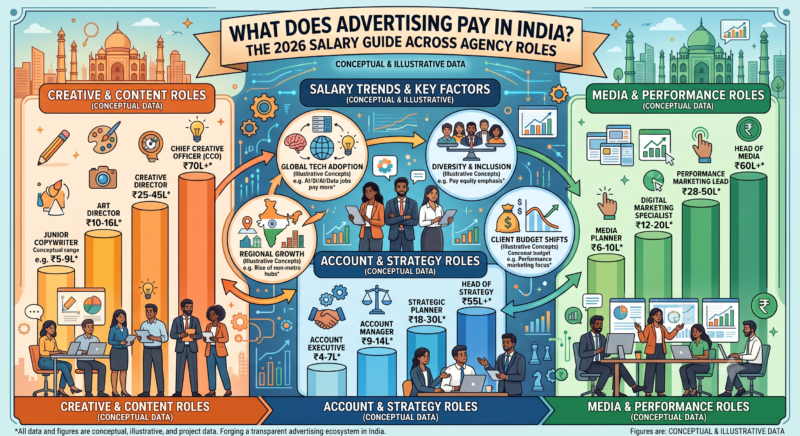
Junior copywriters and designers can earn approximately ₹3 lakh–₹7 lakh annually. Mid-level creatives with several years of experience may reach ₹8 lakh–₹18 lakh, while senior creative leaders can command substantially more.
At the top end, executive creative directors, national creative directors and creative heads at major agencies can receive compensation packages running into several tens of lakhs per year.
Portfolio quality remains particularly important in creative hiring.
Account Management
Account-management professionals sit between clients and agency teams.
An account executive or junior account manager may earn approximately ₹4 lakh–₹8 lakh annually.
Managers and group account managers can move into the ₹10 lakh–₹20 lakh range, while account directors and business heads can earn significantly more depending on the size and complexity of their client portfolios.
Large multinational accounts can carry higher compensation because of the scale of responsibility.
Media Planning And Buying
Media professionals are becoming increasingly valuable as advertising becomes more data-driven.
Junior media planners can earn around ₹4 lakh–₹7 lakh, while experienced planners and buyers may earn ₹8 lakh–₹16 lakh.
Senior media directors and investment leaders can move beyond ₹20 lakh, particularly when responsible for large spending portfolios.
Knowledge of digital platforms, programmatic advertising, measurement and data is becoming increasingly important.
Digital And Performance Marketing
Digital advertising has created some of the industry’s fastest-growing specialist roles.
Performance-marketing executives can earn approximately ₹4 lakh–₹8 lakh early in their careers.
Mid-level specialists can reach ₹8 lakh–₹18 lakh, while senior performance leaders and growth heads can earn ₹20 lakh–₹40 lakh or more at larger organisations.
Skills involving paid search, paid social, conversion optimisation, analytics and marketing automation can influence compensation significantly.
Strategy And Planning
Strategic planning roles typically command higher salaries as experience increases.
Junior planners can earn around ₹5 lakh–₹9 lakh, while experienced planners and strategy managers may fall within the ₹10 lakh–₹22 lakh range.
Strategy directors and planning heads can earn substantially more, particularly at large agencies handling major national brands.
Data And Marketing Technology
The convergence of advertising and technology is creating specialised roles in data analytics, marketing technology and artificial intelligence.
Marketing analysts can earn around ₹5 lakh–₹10 lakh in the early stages of their careers.
Experienced marketing-data, analytics and martech professionals can reach ₹12 lakh–₹25 lakh or more, depending on their technical expertise.
Specialists working with AI, customer data platforms, attribution, marketing automation and advanced analytics can command premiums because these skills are transferable beyond traditional advertising.
Senior Agency Leadership
At the top of the agency hierarchy are managing directors, CEOs, chief creative officers, chief strategy officers and other business leaders.
Compensation varies dramatically. Senior leaders at large agency networks can receive packages ranging from ₹50 lakh to several crore rupees annually, depending on company size, role, performance incentives and business responsibilities.
Variable compensation can represent a significant portion of total pay.
What Determines The Pay Gap?
Experience is only one factor.
Agency size, client portfolio, revenue responsibility, specialist skills, leadership experience and location can all influence compensation.
A performance-marketing specialist managing a large advertising budget may earn more than a similarly experienced generalist. Likewise, a creative director with an internationally recognised portfolio may command significantly more than another professional with the same number of years in the industry.
The Skills Premium In 2026
The advertising industry’s salary structure is increasingly rewarding professionals who can combine creativity with technology and commercial understanding.
AI-assisted production, data analysis, programmatic media, retail media, influencer marketing, connected TV and marketing measurement are creating new career paths.
The traditional advertising career ladder is therefore becoming less linear.
The 2026 Picture
India’s advertising industry still offers a wide range of salaries, from entry-level creative and account roles to high-value leadership positions.
For professionals entering the industry, the biggest salary gains are increasingly associated with specialisation, measurable business responsibility and technology-enabled skills.
For agencies, the challenge is to retain experienced talent while competing with brands, technology companies and digital platforms that can offer alternative career paths.
In 2026, advertising remains a people-driven business—but the skills that command the highest premiums are increasingly the ones that connect ideas, data, technology and business results.