
India’s advertising market is entering 2026 with budgets shifting rapidly toward digital, commerce and measurable media. The country’s total advertising market is projected to reach around ₹2.02 lakh crore in 2026, according to WPP Media, with digital expected to account for the majority of spending.
But which companies and brands are actually putting the biggest money behind advertising?
There is no single public database that captures every rupee spent by every brand across television, digital, print, outdoor, retail media and other channels. Instead, industry datasets provide snapshots of where advertising pressure is highest.
FMCG Still Dominates
Fast-moving consumer goods remain among India’s biggest advertising investors.
The latest dentsu-e4m digital advertising data shows FMCG as the largest contributor to India’s digital advertising market in 2025, with spending of about ₹36,084 crore, up from ₹31,467 crore in 2024. Its share, however, declined from 31% to 30% as other categories expanded faster.
On television, FMCG companies also occupy much of the advertiser leaderboard.
Reckitt Takes TV Lead
Television data for January-July 2026 puts Reckitt Benckiser India at the top of the advertiser rankings, followed by Hindustan Unilever and Godrej Consumer Products.
Cadbury’s India and Coca-Cola India completed the top five. The top 10 advertisers collectively accounted for 43% of television advertising volumes during the period.
At the individual-brand level, Harpic Power Plus 10x Total Clean was the most advertised television brand, followed by Dettol Toilet Soaps and Dettol Antiseptic Liquid. Seven of the top 10 television brands belonged to Reckitt.
HUL Remains A Heavyweight
Hindustan Unilever continues to be one of India’s most visible advertising companies.
TAM AdEx data for calendar 2025 identified HUL as India’s largest television advertiser, accounting for 14% of television ad volumes. The top 10 advertisers together represented 44% of TV advertising volumes that year.
Its portfolio of household and personal-care brands gives the company a presence across multiple advertising categories.
Google And Digital Platforms
Digital advertising tells a different story.
Google and Meta are among the largest recipients of advertising money in India because brands use their platforms extensively for search, social media and performance marketing.
The broader digital advertising ecosystem generated nearly ₹80,000 crore in advertising revenue for technology and e-commerce companies in FY2024-25, according to industry reporting.
This reflects an important distinction: the biggest advertising spenders are not necessarily the same companies as the biggest advertising platforms.
E-Commerce Joins The Race
E-commerce is becoming one of the fastest-growing advertising categories.
Amazon, Flipkart and Myntra together generated ₹15,573 crore in advertising revenue in FY25, up 26% year-on-year. Amazon Seller Services accounted for ₹8,342 crore, while Flipkart Internet generated ₹6,317 crore.
For 2026, Amazon and Flipkart are expected to generate around ₹19,000-20,000 crore in combined advertising revenue, according to Deloitte estimates reported by The Economic Times.
Quick Commerce Enters The Big League
Blinkit, Swiggy Instamart and Zepto are also becoming important advertising platforms.
Quick-commerce advertising revenue is expected to reach about ₹4,900 crore in 2026, compared with approximately ₹3,000 crore in the previous year, according to Datum Intelligence estimates reported by The Economic Times.
The attraction for brands is straightforward: consumers can see an advertisement and purchase the promoted product within the same digital environment.
IPL Changes The Leaderboard
Major sporting events can dramatically alter advertising patterns.
During IPL 2026, Google was the leading advertiser across both connected TV and linear television. On CTV, Google accounted for 14.4% of ad volumes, followed by Havells India, Reliance Consumer Products, Grasim Industries and Amazon Online India.
On linear television, Google again led with a 10.9% share, followed by Reliance Consumer Products and Havells India.
These figures represent advertising volume during the IPL rather than total annual advertising expenditure.
Print Has Its Own Leaders
Print advertising continues to attract significant spending from automotive, education, financial services and consumer brands.
During January-July 2026, Maruti Suzuki India remained the largest print advertiser, followed by Hero MotoCorp and LIC of India. SBS Biotech and GCMMF completed the top five.
The top 10 print advertisers together accounted for 13% of advertising space during the period.
The 2026 Spending Picture
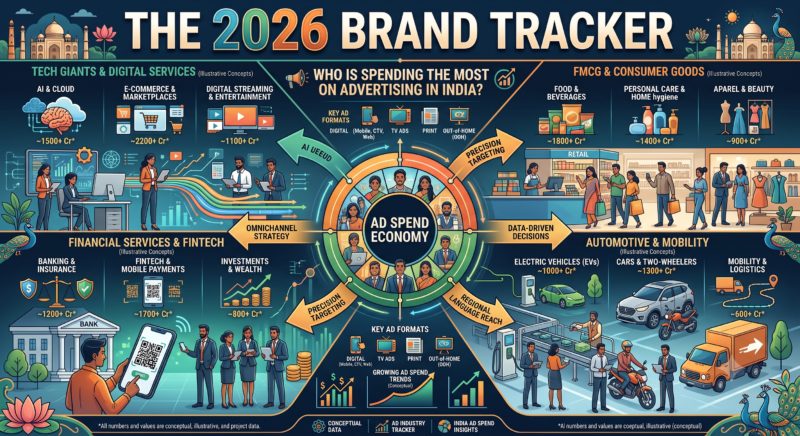
The emerging tracker shows a market where advertising leadership depends increasingly on the medium.
FMCG dominates broad digital and television spending, automotive remains prominent in print, technology companies are major digital advertising platforms, while e-commerce and quick commerce are rapidly building their own media businesses.
The bigger change is the fragmentation of the advertising wallet. India’s market is projected to cross ₹2 lakh crore in 2026, but that money is increasingly distributed across search, social media, streaming, connected TV, retail media, quick commerce, television and traditional media.
For brands, the 2026 advertising race is therefore no longer simply about spending the most. It is increasingly about deciding where the next advertising rupee can reach consumers most effectively—and how clearly its impact can be measured.