


India’s advertising market is becoming increasingly automated. As brands shift larger portions of their budgets toward digital platforms, programmatic advertising is emerging as an important part of the machinery that connects advertisers with websites, apps, video platforms, and other digital properties.
Programmatic advertising uses software, algorithms, and automated auctions to buy and sell digital advertising inventory. Instead of negotiating every advertising placement manually, advertisers can use technology to identify audiences, bid for available impressions, and deliver ads in real time.
India’s digital advertising market reached about ₹49,000 crore in FY2024-25, accounting for 44% of total advertising expenditure, according to the ET Brand Equity-Ipsos State of Digital Advertising in India 2025-26 report.
What Is Programmatic Advertising?
At its simplest, programmatic advertising is automated media buying.
An advertiser decides who it wants to reach, where it wants the advertisement to appear, how much it is prepared to pay, and what results it wants to achieve. Technology then searches available advertising inventory and makes buying decisions according to those instructions.
A large part of this process can happen in milliseconds.
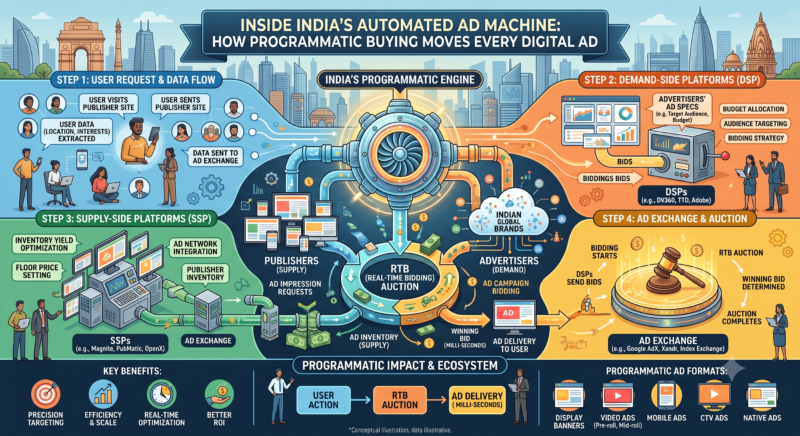
The DSP: Buyer’s Control Room
The demand-side platform, or DSP, is used by advertisers and agencies to purchase advertising inventory.
Through a DSP, marketers can upload creative material, define audiences, set budgets, establish bidding strategies, and determine where their advertisements should appear.
The DSP can evaluate advertising opportunities across multiple publishers and exchanges rather than requiring the advertiser to negotiate separately with every website.
The SSP: Publisher’s Marketplace
On the other side is the Supply-Side Platform, or SSP.
Publishers use SSPs to manage and sell advertising space on their websites, apps, and other digital properties. The SSP helps publishers make available inventory accessible to multiple potential buyers while applying rules around pricing, placements, and advertisers.
In simple terms, the DSP represents demand from advertisers, while the SSP represents advertising supply from publishers.
The Ad Exchange Connects Them
The ad exchange acts as a marketplace connecting buyers and sellers.
When an advertising opportunity becomes available, the exchange can send information about the impression to connected buying platforms. DSPs then determine whether the opportunity matches an advertiser’s targeting requirements and whether it is worth bidding on.
The exchange facilitates the transaction between the demand and supply sides.
What Happens in Milliseconds?
Consider a consumer opening a news website.
The publisher has an advertising slot available. Its technology sends an advertising request into the programmatic ecosystem.
Connected DSPs evaluate the opportunity. They may consider factors such as the campaign’s audience requirements, location, device, content environment, and bidding strategy.
Eligible advertisers submit bids. The auction is processed, a winning bid is selected according to the marketplace rules, and the corresponding advertisement is delivered.
All of this can happen before the webpage has finished loading.
Where Does the Money Go?
The advertiser’s payment does not necessarily flow directly to the publisher.
A programmatic transaction can involve several participants, including the DSP, SSP, ad exchange, data or measurement providers, agencies, and other technology intermediaries.
Each participant may charge a fee or take a share depending on the commercial arrangement.
That means the amount an advertiser spends and the amount ultimately received by a publisher can be different.
Why Brands Use It
Programmatic advertising gives marketers access to large amounts of inventory while allowing campaigns to be managed according to specific targeting and performance objectives.
It can also make it easier to adjust campaigns based on results. Budgets, bids, audiences, and creative strategies can be modified without renegotiating every individual placement.
For a market as large and diverse as India, automation can be particularly useful when advertisers need to reach audiences across thousands of digital properties.
Where India Is Heading
India’s digital advertising market is continuing to expand, supported by smartphones, e-commerce, online video, and growing digital consumption. Sensor Tower estimated that India’s digital advertising market exceeded $4.2 billion in 2025.
Programmatic advertising is also becoming more sophisticated as artificial intelligence and automated optimization are incorporated into campaign management.
However, automation does not eliminate challenges. Advertisers still need to monitor brand safety, fraud, viewability, privacy, data quality, and the transparency of advertising fees.
The Real Ad-Tech Equation
The programmatic ecosystem can appear complicated because several technologies sit between the advertiser and the publisher.
But its basic structure is straightforward:
Advertiser → DSP → Ad Exchange → SSP → Publisher → Consumer
The technology makes the buying process faster and more scalable, while the auction determines which advertiser gets an individual advertising opportunity.
As India’s digital economy grows, understanding this chain is becoming increasingly important—not only for marketers buying media but also for publishers trying to monetize their audiences and consumers navigating an increasingly automated advertising environment.