




Advertising Moves Closer to the Sale
For years, digital advertising focused on attracting attention through impressions, clicks, video views and website visits. Today, Indian brands are increasingly interested in a more direct question: how effectively does advertising contribute to sales?
This shift is reshaping the relationship between marketing, e-commerce and consumer behaviour. Advertisers want campaigns that do more than make products visible. They want to reach shoppers when purchase decisions are being made and understand which investments generate measurable business results.
The scale of this transformation is highlighted in the FICCI-EY report on India’s media and entertainment industry. Released in March 2026, the report estimates that India’s digital advertising revenue grew 26% in 2025 to ₹94,700 crore, accounting for approximately 63% of total advertising revenue.
The Shopping Platform Becomes an Advertising Channel
E-commerce platforms are no longer simply destinations where consumers discover and purchase products. Their search results, product listings, recommendation systems and promotional placements have also become advertising opportunities.
Brands can promote products to shoppers already searching for particular categories. This creates a different environment from conventional display advertising, where consumers may encounter an advertisement while doing something unrelated to shopping.
For advertisers, the attraction is relevance. A customer searching for skincare products, electronics or household essentials may already have a clear purchase intention. Appearing at that moment can help a brand compete for attention when it matters most.
However, visibility does not automatically translate into sales. Product quality, pricing, reviews, availability and delivery experience continue to influence purchasing decisions.
Quick Commerce Adds a New Dimension
The expansion of quick-commerce platforms has further strengthened the connection between advertising and purchasing. Consumers can discover products, compare options and place orders within the same digital environment.
This creates opportunities for brands in categories such as packaged foods, personal care, beverages and everyday household products. Sponsored listings and other promotional placements can help products stand out in crowded digital catalogues.
The FICCI-EY industry report highlights the growing importance of e-commerce and point-of-sale advertising, which increased by 50% in 2025 to ₹22,000 crore.
For marketers, the challenge is to determine whether these placements generate additional purchases or simply capture sales that would have occurred anyway.
Measurement Becomes the Competitive Advantage
Commerce-driven advertising promises clearer connections between marketing expenditure and business outcomes. Yet meaningful measurement requires more than counting orders attributed to an advertisement.
Brands must distinguish between sales directly associated with a campaign and genuinely incremental sales that would not otherwise have happened.
For example, an advertisement may receive credit for a purchase from a customer who had already decided to buy the product. Without a suitable measurement approach, a campaign could appear more effective than it actually is.
Advertisers should therefore examine incremental sales, return on advertising spend, customer acquisition costs, repeat purchases and profit margins. These indicators provide a more balanced picture of campaign performance.
The Challenge of Fragmented Data
As brands advertise across marketplaces, quick-commerce applications, social networks and their own websites, performance data becomes scattered across different platforms.
Each platform may use its own attribution windows, reporting methods and definitions of success. Comparing campaign results can consequently become difficult.
Marketing teams need consistent measurement frameworks and clear objectives before allocating budgets. They should also consider privacy requirements and ensure that customer information is collected and used responsibly.
Better reporting is not simply a technology issue. It requires coordination between marketing, finance, analytics and sales teams.
What Brands Should Do Next
Businesses should begin by identifying the role commerce-driven advertising plays in their wider marketing strategy. Some campaigns may be designed to generate immediate purchases, while others build awareness and influence future demand.
Brands should test placements on relevant platforms, establish performance benchmarks and evaluate results over an appropriate period. They should also monitor profitability rather than relying exclusively on revenue or attributed conversions.
Smaller businesses can benefit by starting with focused product categories and limited experiments before expanding investment.
From Advertising Spend to Business Growth
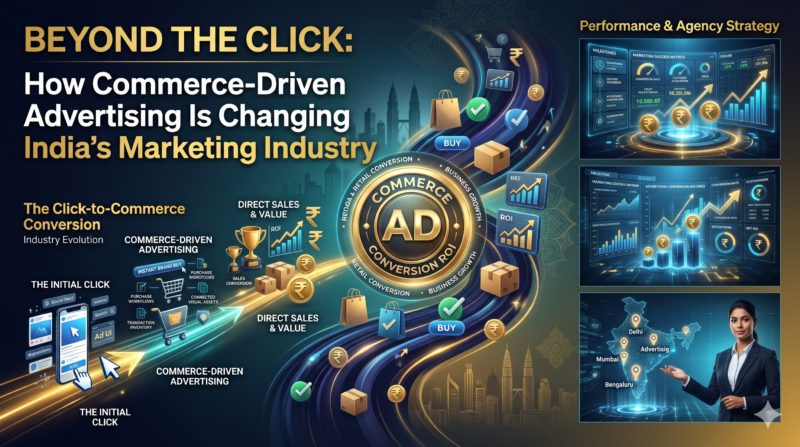
Commerce-driven advertising is changing how brands evaluate digital marketing. The emphasis is shifting from exposure alone towards measurable commercial outcomes, supported by shopping platforms, product discovery tools and improved campaign analytics.
Yet the most effective strategy will not be to abandon brand building in favour of immediate conversions. Sustainable growth requires both: creating demand and making it easier for customers to act on that demand.
For Indian advertisers, the next competitive advantage may come from connecting these two objectives while measuring results with greater discipline.