




The New Creative Advantage
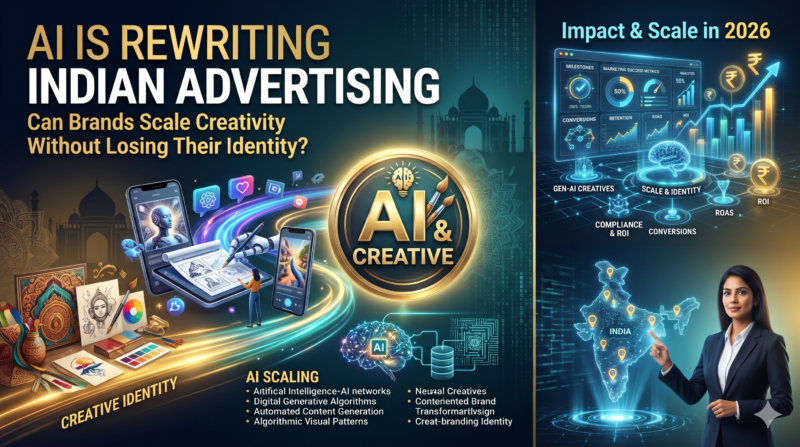
Advertising has always depended on the ability to capture attention with the right message at the right moment. Today, artificial intelligence is changing how quickly brands can research audiences, develop creative concepts and produce campaign variations.
For Indian businesses operating across multiple languages, regions and digital platforms, these tools offer an opportunity to make advertising production more flexible. A single campaign concept can be adapted into different formats, headlines and visual styles without rebuilding every asset from scratch.
But faster production does not automatically mean better advertising. The real challenge is using AI to improve creative quality while protecting brand identity, accuracy and consumer trust.
From One Advertisement to Hundreds of Variations
Traditional advertising production can involve several rounds of copywriting, design, editing and approval. Generative AI can assist with parts of this process by suggesting headlines, generating draft images, adapting copy and helping teams explore creative directions.
Google’s advertising products increasingly incorporate AI-assisted creative and campaign features. Its official Google Ads AI Essentials guide outlines how advertisers can combine AI-powered tools with strong measurement practices.
For example, a fashion retailer could develop multiple versions of a campaign for different product categories. A restaurant chain might test alternative promotional messages, while a consumer technology company could create variations for search, display and video advertising.
These applications can reduce repetitive work and give creative teams more time to focus on strategy, storytelling and refinement.
Why Human Creativity Still Matters
AI can generate plausible ideas, but it does not automatically understand a brand’s history, cultural context or relationship with consumers.
Indian advertising often depends on language, humour, local references and social nuances. A slogan that works in one region may sound unnatural or carry an unintended meaning in another.
Human review is therefore essential. Creative teams should verify translations, check product claims, assess visual details and ensure that generated content reflects the brand’s intended personality.
The strongest workflow treats AI as a creative assistant rather than an unquestioned decision-maker. People establish the brief, select the direction, refine the output and approve the final advertisement.
Transparency Is Becoming Part of the Process
As AI-generated imagery and video become more common, advertisers must consider how audiences understand the content they see.
In July 2026, Google announced additional advertising transparency features, including a “How this ad was made” panel designed to help users understand when generative AI was used to create or alter an advertisement.
Official source: Google — Expanding AI Transparency in Ads.
Meta has also described its approach to AI transparency in advertising, including information about ads created or significantly edited using generative AI tools.
Official source: Meta — AI Transparency for Ads.
Platform-specific disclosure requirements may differ and evolve. Advertisers should check the applicable rules before publishing, particularly when an advertisement contains realistic synthetic people, altered imagery or claims that could mislead consumers.
The Data Question
AI-driven marketing can also depend on customer data, campaign analytics and audience signals. This makes responsible data management an important part of advertising strategy.
Indian businesses should review their data practices against applicable requirements under the Digital Personal Data Protection Act, 2023, and the notified rules.
Official reference: Ministry of Electronics and Information Technology — Digital Personal Data Protection Act.
Marketers should understand what information they collect, why they need it and how it is used. Personalisation should not become an excuse for collecting unnecessary information or making unsupported assumptions about consumers.
How Brands Should Measure AI’s Impact
The value of AI should be measured through business outcomes rather than the number of assets produced.
Marketing teams can compare production time, creative costs, campaign conversion rates, customer acquisition costs and the performance of different creative variations.
Controlled experiments are particularly useful. If a campaign using AI-assisted creative performs better, teams should investigate whether the improvement came from the message, visual execution, audience selection or another factor.
Brands should also monitor quality failures, inaccurate claims, repetitive creative and audience complaints. Faster production has limited value if it increases the risk of reputational damage.
The Future Belongs to Disciplined Experimenters
AI is lowering some of the barriers to producing advertising content, but it is not removing the need for good ideas. Strategy, cultural understanding, brand consistency and clear measurement remain essential.
Indian brands that experiment carefully can use AI to accelerate routine work, explore more creative options and improve campaign learning. Those that simply automate content production risk flooding platforms with advertisements that look polished but feel interchangeable.
The next competitive advantage will not come from using the most AI tools. It will come from combining technology with distinctive creative thinking, responsible data practices and a clear understanding of what makes a brand worth remembering.