




A Different Way to Sell Online
For a small retailer, entering e-commerce has traditionally meant joining an established marketplace, building a standalone online store or depending on social media to attract customers. Each option comes with its own challenges, from customer acquisition and technology costs to logistics and competition for visibility.
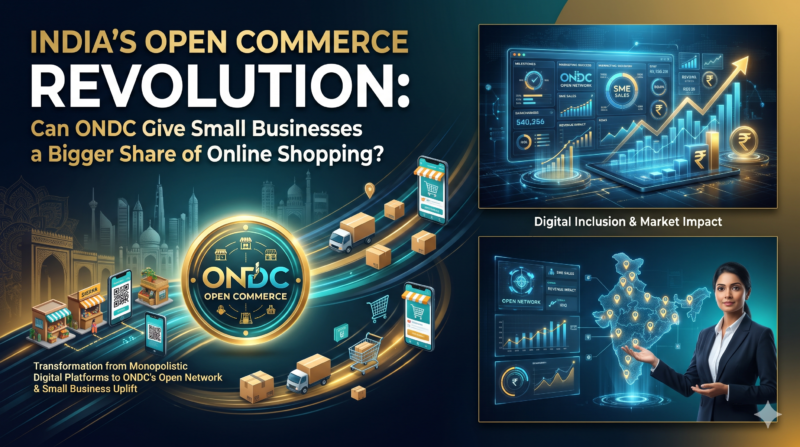
India’s Open Network for Digital Commerce (ONDC) is exploring a different model: connecting buyers, sellers and service providers through an interoperable network rather than keeping every transaction within a single marketplace.
The initiative, developed under the Department for Promotion of Industry and Internal Trade (DPIIT), aims to make digital commerce more accessible to businesses of different sizes. Its potential significance lies in giving local merchants another route to reach online consumers.
Official website: ONDC
The Numbers Behind the Network
The government reported that, as of December 9, 2025, more than 116,000 retail sellers were live on ONDC across over 630 cities and towns. A separate government update stated that approximately 206,000 merchants had completed at least one transaction on the network by December 31, 2025.
These figures measure different things: sellers who were live on the network and merchants who had completed at least one transaction. They should not be treated as interchangeable measures of active businesses or repeat customers.
Nevertheless, the figures demonstrate the scale of participation being pursued through open digital-commerce infrastructure.
Official sources: Ministry of Commerce and Industry — ONDC update and Ministry of MSME — Digital adoption update.
How Open Commerce Works
ONDC is not itself a conventional shopping app. It provides common protocols that allow compatible buyer applications, seller applications and logistics providers to connect.
A participating seller can make its catalogue discoverable through the network, while consumers can use compatible buyer applications to discover available products and services. Logistics partners can support the movement of orders between sellers and customers.
This approach separates parts of the shopping journey that are often controlled within a single platform.
The model does not mean every seller automatically appears on every application or receives equal sales. Participation depends on compatible network arrangements, category availability, service coverage and commercial terms.
Still, interoperability creates the possibility of broader discovery without requiring every seller to develop an entirely separate technology system.
Why Small Businesses Could Benefit
For neighbourhood retailers, artisans, food businesses and smaller consumer brands, digital commerce can open access to customers beyond their immediate surroundings.
A local store may have products that appeal to consumers elsewhere but lack the resources to develop a sophisticated e-commerce operation. Network-based infrastructure can help reduce some entry barriers by connecting participating sellers with digital commerce applications and service providers.
The government has also described the Trade Enablement and Marketing (TEAM) scheme, which supports the digital-commerce participation of micro and small enterprises, self-help groups, farmer producer organisations, artisans and rural entrepreneurs.
The scheme includes support for digital literacy, catalogue preparation and onboarding, helping businesses address practical barriers to online selling.
Official reference: DPIIT — Internal Trade and E-Commerce.
The Challenges That Remain
Being listed online is only the first step. Sellers must still manage product quality, pricing, packaging, inventory, returns and customer service.
They also need to understand the economics of each transaction. Delivery costs, discounts, payment-related charges and platform or service fees can affect margins. A higher order count does not necessarily mean a more profitable business.
Consumer trust is another consideration. Buyers expect accurate product information, dependable delivery and a clear process for resolving complaints. Network participants must work together to provide a consistent experience.
For ONDC to create lasting value, sellers need more than access to technology. They need practical support in digital operations, customer retention and business planning.
What It Means for India’s E-Commerce Market
The larger question is whether open networks can make digital commerce more competitive and inclusive while maintaining a reliable shopping experience.
Traditional marketplaces may continue to attract consumers through convenience, fulfilment systems, brand selection and established customer relationships. Open-commerce networks offer a different approach, based on interoperability and participation by multiple technology and service providers.
The two models need not be mutually exclusive. A business may choose several sales channels, depending on its products, customers and operating capacity.
For marketers, this evolving landscape also creates questions about customer acquisition, product discovery and brand visibility. As more routes to online commerce develop, businesses will need to evaluate which channels deliver profitable sales rather than simply expanding their digital presence.
The Road Ahead
ONDC’s progress should ultimately be judged by outcomes: how many sellers generate sustained business, whether customer acquisition becomes more affordable, whether repeat purchases increase and whether consumers receive reliable service.
The network’s expansion offers a promising direction for Indian digital commerce, but participation figures alone cannot establish commercial success.
India’s next e-commerce chapter may be defined not only by the growth of large platforms, but also by the ability of smaller businesses to participate in the digital economy on sustainable terms. Open commerce is one attempt to make that possible—and its long-term impact will depend on how effectively infrastructure translates into real business growth.