
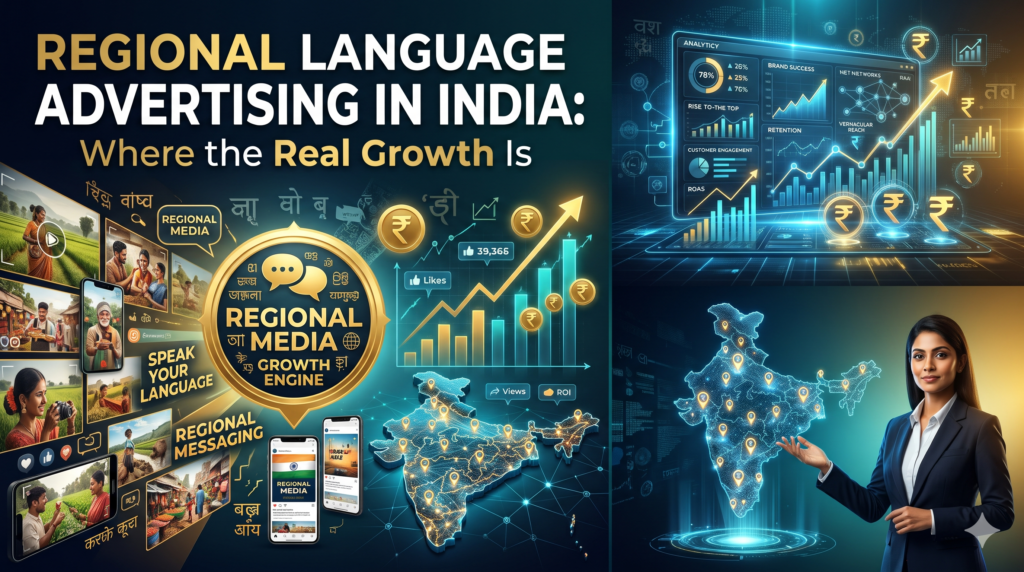
India’s next advertising opportunity is not simply about reaching more people. It is about speaking to them in the languages, cultural references and everyday experiences that make brands feel relevant. As digital consumption expands beyond English-first audiences, regional language advertising is becoming a strategic priority for marketers.
1. The Opportunity Beyond English
India’s advertising market has traditionally relied heavily on Hindi and English for national campaigns. But consumer behaviour online reveals a more complex picture.
The Internet and Mobile Association of India (IAMAI) and Kantar’s Internet in India 2023 report found that 57% of urban Indian internet users preferred accessing internet content in Indic languages. Among users undertaking online activities in Indic languages, video viewing was especially prominent.
These findings highlight an important commercial opportunity: consumers are not simply consuming content in regional languages. They are using those languages to discover information, watch entertainment and explore products.
The official IAMAI and Kantar report provides a useful foundation for understanding this shift.
For advertisers, the implication is clear. A campaign designed exclusively for English-speaking audiences may miss opportunities to connect with consumers who prefer a different language or cultural context.
2. Hindi Is Important, but It Is Not the Whole Market
Hindi remains a major advertising language, particularly for brands seeking reach across northern and central India. However, treating Hindi as a substitute for every regional language can limit a campaign’s relevance.
Tamil, Telugu, Bengali, Marathi, Kannada, Malayalam, Gujarati, Punjabi and other languages connect brands with distinct cultural and consumer environments.
Even within a language market, preferences can differ between cities, smaller towns and rural communities. A campaign that works in one location may need different expressions, humour or examples elsewhere.
India’s official Census language tables provide detailed information on mother tongues across the country. Although the latest complete published language census data are from 2011, the tables demonstrate the country’s extensive linguistic diversity.
The marketing lesson is not to create a separate campaign for every language automatically. It is to understand where language meaningfully influences consumer discovery, comprehension and purchase decisions.
3. The Biggest Opportunity Is in Digital Video
Short-form video, creator content and regional entertainment provide natural environments for language-led advertising.
Consumers can hear a product explained in a familiar accent, see it used in an everyday situation and connect it with cultural references they recognise.
For brands, this creates opportunities across categories such as personal care, packaged food, financial services, smartphones, education and e-commerce.
Regional-language video can serve several purposes: building awareness, demonstrating a product, answering questions and supporting conversions.
Google’s Think with Google research on app and website localisation in India discusses the importance of language preferences in digital experiences.
The commercial challenge is to create content that feels native to the audience rather than translating an English advertisement word for word.
4. Localisation Is More Than Translation
A common mistake is to produce one national advertisement and replace its voice-over with different languages.
Translation can improve comprehension, but effective localisation also considers humour, idioms, social context, cultural references and the way people discuss a product.
For example, an advertisement for a household product may need a different opening situation or demonstration to feel natural to audiences in different regions.
A financial services campaign may require particularly careful language choices because consumers need to understand fees, eligibility, risks and product conditions accurately.
The best process combines a clear central brand idea with local creative adaptation. Native-language writers, regional researchers and local creators can help ensure the result feels authentic.
5. Regional Creators Can Make Brands More Relatable
Regional-language creators often build communities around local entertainment, food, fashion, education, travel and everyday life.
Their appeal comes from more than language. Audiences may identify with their humour, accent, interests and familiarity with local concerns.
Brands can collaborate with creators to demonstrate products, answer questions or develop culturally relevant campaigns.
However, follower counts alone are not enough. Advertisers should evaluate audience location, engagement quality, brand suitability and the creator’s ability to communicate product information responsibly.
Regional partnerships can also help brands discover new consumer insights. Questions and comments may reveal the language consumers use to describe their needs, objections and expectations.
6. AI Is Making Regional Campaigns Easier to Scale
Artificial intelligence is helping marketers generate draft translations, subtitles, voice-overs and creative variations. These capabilities can reduce some production bottlenecks when brands need content across multiple languages.
But automation does not eliminate the need for human review. Literal translations can sound unnatural, synthetic voices can miss emotional nuance, and cultural references can be misinterpreted.
A responsible workflow uses technology for speed while relying on native-language professionals to verify meaning, tone, pronunciation and factual accuracy.
This is particularly important in regulated categories such as financial services and healthcare, where unclear or misleading claims can have serious consequences.
7. How Brands Should Measure Regional Advertising
The value of regional advertising should be assessed through more than views or impressions.
Marketers can compare language versions using measures such as:
- Reach and frequency: Are the intended audiences seeing the campaign?
- Engagement: Are viewers watching, sharing or responding?
- Brand understanding: Do consumers understand the product and its benefits?
- Conversion: Are people taking meaningful actions after exposure?
- Incremental growth: Does the campaign reach new customers or improve results beyond existing activity?
Tests should compare similar audiences and campaign conditions wherever possible. Otherwise, differences in results may reflect placement, targeting, pricing or creative execution rather than language alone.
8. Where the Real Growth Lies
The strongest opportunity is not necessarily in the language with the largest population. It is where three factors meet: a reachable audience, a relevant product and a genuine need for local-language communication.
A brand selling across India may prioritise different languages for different products, regions and customer journeys. It may use regional video for awareness, local-language landing pages for consideration and familiar-language support to help customers complete a purchase.
The winning approach combines national brand consistency with regional relevance.
The Final Word
Regional language advertising is not merely an adaptation exercise. It is a way to make brands more accessible, understandable and culturally relevant to India’s diverse consumers.
The opportunity is particularly compelling in digital video, creator partnerships, e-commerce and services that depend on consumer trust.
The brands most likely to benefit will not simply speak more Indian languages. They will understand how people in different markets live, think, discover products and make decisions, then build advertising around those realities.