
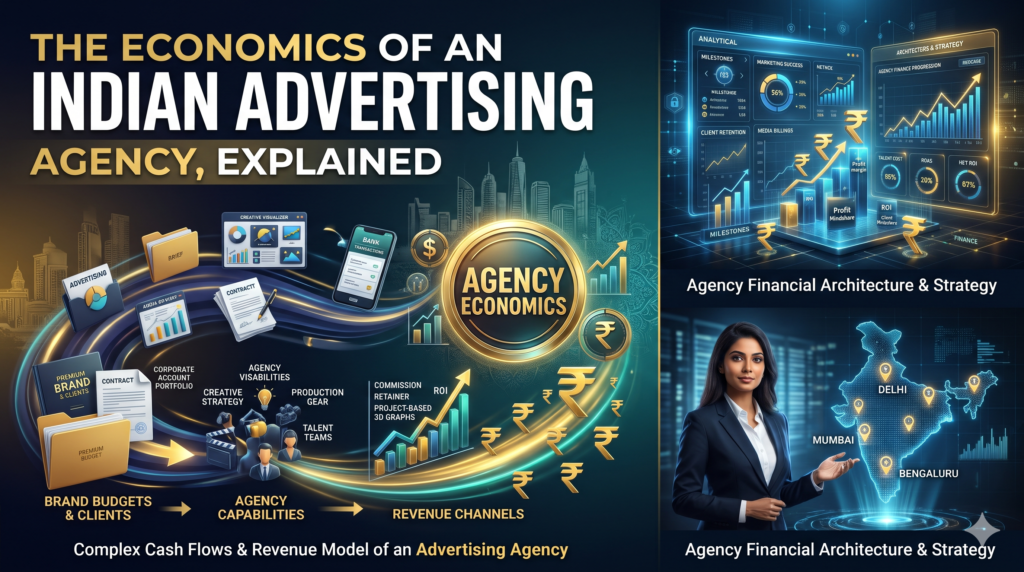
Behind every memorable campaign is a business that must manage salaries, client fees, production budgets, payment delays and profit margins. Understanding how an advertising agency makes money reveals why creative talent alone is not enough to build a sustainable agency.
1. Revenue Is Not the Same as Profit
An advertising agency may handle campaigns worth several crores of rupees without earning anything close to that amount as income.
Consider a brand that allocates ₹50 lakh for a campaign. The budget might include media placements, video production, influencer payments, research and the agency’s professional fees. Much of that money may go directly to external suppliers rather than remaining with the agency.
This distinction is central to agency economics. The amount billed to a client is not necessarily the amount available to pay salaries, rent, software subscriptions and other operating expenses.
Global advertising group WPP makes this distinction in its official 2025 annual report, which separates total revenue from revenue less pass-through costs. Its reporting explains that pass-through costs include media and other external supplier expenses charged directly to clients.
For an Indian agency, the same principle applies: billing volume can look impressive while the actual revenue available to run the business remains relatively small.
2. How Advertising Agencies Make Money
Most agencies combine several revenue models, depending on their size, specialisation and client relationships.
Monthly retainers: Clients pay a recurring fee for ongoing services such as social media management, brand communication, campaign planning or creative support.
Project fees: Agencies charge for defined assignments, including brand identity development, product launches, advertising campaigns and website projects.
Media management fees: Agencies may receive a fee for planning, buying or managing advertising campaigns. The commercial arrangement should be clear about whether media costs are paid directly by the client or handled by the agency.
Production and execution fees: Agencies coordinate video shoots, photography, design production, events and other campaign activities. Their income depends on the agreed fee structure and the costs they incur.
Strategy and consulting fees: Specialist agencies may charge for research, positioning, brand strategy, workshops and marketing advice.
A healthy agency understands which services generate reliable income, which require significant external expenditure and which create opportunities for longer-term client relationships.
3. The Biggest Expense Is Usually People
Advertising is a people-intensive business. Copywriters, designers, art directors, strategists, account managers, media specialists and production professionals collectively deliver the work clients pay for.
Consider a hypothetical independent agency with eight employees and a monthly payroll of ₹6 lakh. Its annual payroll alone would be ₹72 lakh, before employer contributions, software, rent, freelancers, travel and other expenses.
This creates a basic economic requirement: the agency must generate enough revenue to cover its team and operating costs while leaving a reasonable profit.
Hiring too early can strain finances. Hiring too late can damage quality and cause missed deadlines.
The challenge is to maintain the right balance between billable work, creative quality and available capacity.
4. A Sample Agency Profit-and-Loss Statement
The following example illustrates how a small Indian agency might perform financially over one month. These are hypothetical figures, not industry averages.
| Monthly financial item | Amount |
|---|---|
| Client fees and other earned revenue | ₹12,00,000 |
| Salaries and employee costs | ₹5,00,000 |
| Freelancers and production support | ₹1,50,000 |
| Rent, software and administration | ₹1,00,000 |
| Sales, travel and other expenses | ₹75,000 |
| Operating profit before interest and tax | ₹3,75,000 |
| Operating margin | 31.25% |
In this simplified example, the agency earns ₹12 lakh in monthly revenue and retains ₹3.75 lakh as operating profit before interest and tax.
The margin is illustrative and should not be treated as a typical industry outcome. Actual margins depend on pricing, utilisation, staff costs, project mix, bad debts and the amount of external work required.
The table also assumes that the ₹12 lakh represents earned agency revenue after excluding client pass-through spending.
5. Why Cash Flow Can Be More Important Than Profit
An agency can report a profit on paper and still struggle to pay its employees.
Imagine that an agency completes a campaign in April but receives payment from the client in June. Salaries, rent and freelancer invoices may be due throughout April and May.
If the agency lacks sufficient cash reserves, even a profitable assignment can create a financial problem.
This is why payment terms, advance billing, milestone payments and consistent follow-ups matter. Agencies should also agree on how production costs and media budgets will be funded before committing to suppliers.
A clear contract should specify payment deadlines, late-payment provisions, approval processes and what happens when a client delays or changes the scope of work.
The goal is not simply to win business. It is to ensure that completed work turns into cash at a sustainable pace.
6. Why Agencies Sometimes Lose Money on Big Accounts
A large client can increase an agency’s reputation and revenue, but it can also create financial pressure.
The problem often begins when the agency underprices its services to win the pitch. The client then requests additional deliverables, more revisions, urgent work or extra meetings that were not included in the original agreement.
The agency may continue delivering the work without adjusting the fee.
Over time, the account consumes more staff hours than planned and becomes less profitable.
A disciplined agency defines the scope clearly, sets revision limits, tracks time and discusses additional fees when requirements change.
It also evaluates accounts based on profitability and payment reliability, not just the size of the client’s name or annual billing.
7. The Role of Technology and AI
Technology can improve agency economics when it reduces repetitive work, accelerates production or helps teams understand campaign performance.
AI-assisted tools can support initial copy drafts, creative adaptations, research summaries and reporting. Project management systems can help teams monitor deadlines, workloads and approvals.
However, technology also introduces subscription expenses, training requirements and additional quality-control responsibilities.
Agencies should measure whether these investments improve productivity, reduce turnaround times or increase the value of their services. Saving time on production is useful only if that time is put to better use or translates into a measurable business benefit.
8. Compliance Is Part of the Business Model
Indian agencies must consider contracts, invoicing, tax obligations, employee costs and advertising regulations.
GST treatment depends on the nature of the service, the supplier’s circumstances and applicable rules. Agencies should distinguish their professional fees from amounts collected for media or third-party services and maintain appropriate documentation.
The official GST portal provides access to registration, returns and related compliance resources. The Central Board of Indirect Taxes and Customs publishes official GST information and guidance.
Because arrangements vary, agencies should obtain qualified accounting advice rather than assume that every client billing or pass-through expense receives identical tax treatment.
9. What Makes an Agency Financially Strong?
A sustainable agency does more than produce good creative work. It understands its cost structure, prices projects carefully, maintains a manageable workload and collects payments reliably.
The most useful indicators include:
- Revenue earned from professional services, excluding pass-through costs where appropriate.
- Gross profit and operating margin.
- Staff utilisation and delivery costs.
- Client concentration and recurring revenue.
- Average payment time and outstanding invoices.
- Profitability by client, project and service.
Monitoring these figures helps agency founders decide when to hire, which services to expand and which accounts require commercial renegotiation.
The Final Word
The economics of an Indian advertising agency come down to the relationship between what clients pay, what the agency actually earns and what it costs to deliver the work.
A strong creative reputation can attract clients, but sustainable growth requires disciplined pricing, efficient operations and reliable cash flow.
The best agency is not necessarily the one that bills the most or wins the biggest account. It is the one that consistently delivers excellent work while building a financially healthy business.