
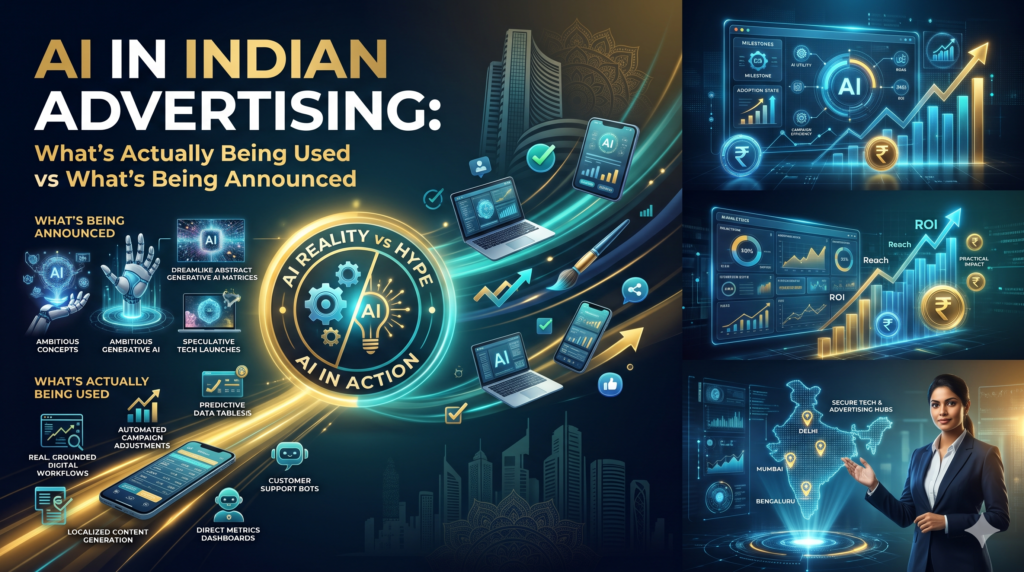
Artificial intelligence is changing how Indian advertising campaigns are planned, produced and delivered. But behind the excitement around generative AI, a more practical transformation is taking place: automating repetitive tasks, producing creative variations and improving campaign optimisation while human teams continue to shape the ideas.
1. Beyond the AI Hype
AI has become one of advertising’s biggest talking points. Agencies discuss AI-powered creativity, brands experiment with synthetic imagery, and advertising platforms introduce tools that generate headlines, videos and campaign assets.
Yet there is an important distinction between announcing a capability and using it to deliver advertising at scale.
The clearest applications today are often practical rather than spectacular. AI can help marketers develop draft copy, adapt images for different formats, analyse campaign performance, personalise messages and automate parts of media buying.
For Indian advertisers managing campaigns across multiple languages, regions and digital platforms, these capabilities can reduce production bottlenecks. However, they still require creative direction, cultural understanding, approval processes and performance measurement.
The more useful question is not whether an agency uses AI. It is which part of its workflow AI improves, and whether that improvement produces better work or better business results.
2. What’s Already Being Used: Automated Media Buying
One of AI’s most established applications is campaign optimisation.
Google Ads uses machine learning to help advertisers match ads with relevant audiences, adjust bidding and optimise campaigns. Its Performance Max campaigns use Google’s advertising inventory and automated optimisation capabilities to pursue goals such as conversions and sales.
Google is also expanding AI-assisted search advertising. Its official AI Max announcement explains how AI can expand search-term matching, customise advertising text and select relevant landing pages.
For Indian brands, the practical benefit is the ability to manage complex campaigns with less manual intervention. Marketers can spend less time adjusting individual settings and more time improving creative assets, offers and landing pages.
Automation is not the same as guaranteed performance. Results still depend on campaign objectives, conversion tracking, data quality, budget and the product being advertised.
3. Generative AI Is Entering Creative Production
AI-generated copy and images are moving beyond experimental demonstrations into advertising workflows.
Google’s official India marketing platform updates describe tools that help advertisers generate creative assets and develop campaigns. Meta has also introduced generative AI capabilities in its advertising products, including tools for creating or significantly editing advertising imagery.
For brands running frequent promotions, these tools can help produce variations of headlines, backgrounds, product presentations and other creative assets.
Meta’s official explanation of generative AI transparency in advertising also outlines how AI-generated or significantly edited advertising imagery can be labelled.
The practical use case is straightforward: instead of rebuilding every asset manually, a creative team can generate starting points, adapt approved designs and review multiple options.
However, AI-generated output still needs checking for factual accuracy, visual errors, brand consistency and cultural suitability. A product image that looks convincing but misrepresents the product can create more problems than it solves.
4. Indian Campaigns Are Exploring AI as a Creative Idea
AI is not being used only behind the scenes. It can also become the subject of an advertising campaign.
An example is Cadbury Silk’s AI Knows Nothing campaign, developed by Ogilvy India. The campaign explored how people increasingly use AI to guide personal relationships, contrasting technological assistance with the human emotions involved in love.
Ogilvy’s official campaign case study documents the work.
The distinction is important. The campaign’s premise was not simply to use AI to produce an advertisement more cheaply. It used the public conversation around AI as a creative theme.
This demonstrates two different roles for the technology: AI can help create advertising, and advertising can explore what AI means to consumers.
Neither approach removes the need for a human-led creative idea.
5. Content Production Is Becoming More Automated
One of the biggest opportunities for AI lies in producing large volumes of routine creative material.
A consumer brand might need dozens of versions of a campaign for different products, languages, audiences, promotions and screen sizes. Producing every variation from scratch can consume substantial time and resources.
Adobe’s Firefly Creative Production platform is designed to help enterprise teams automate workflows for campaign variations, product imagery, localisation and other high-volume content tasks.
For Indian brands operating across regional markets, this type of workflow could help adapt approved creative assets more efficiently.
The important word is adapt. Translation, local references, product claims and cultural nuance still require careful review. A technically accurate translation may not sound natural to the intended audience.
AI can increase production capacity, but the quality of the final work depends on the brief, source material and review process.
6. What’s Still More Announcement Than Transformation?
Not every AI announcement represents a mature, widely deployed advertising workflow.
Several areas require more caution:
- Fully autonomous campaigns: AI can automate specific tasks, but brands still need people to define objectives, approve budgets and oversee performance.
- Entirely AI-created brand identities: Generative tools can explore visual directions, but distinctive positioning and long-term brand consistency require strategic decisions.
- Guaranteed sales through AI: Automated targeting and bidding cannot compensate for weak products, poor pricing or an ineffective customer experience.
- Human-free creative departments: Generating assets is different from understanding audiences, developing original concepts and taking responsibility for advertising claims.
A product launch, pilot or demonstration proves that a capability exists. It does not automatically prove that the capability is widely adopted, cost-effective or commercially successful.
Advertisers should look for documented results, repeatable workflows and clear accountability rather than relying on impressive demonstrations alone.
7. What Indian Agencies and Brands Should Measure
The real test of AI adoption is whether it improves the business.
Marketing teams should evaluate:
- Production efficiency: Does the workflow reduce the time required to create and approve assets?
- Creative performance: Do the new variations improve meaningful campaign metrics?
- Cost effectiveness: Are savings greater than the costs of software, implementation and review?
- Brand safety: Are generated assets accurate, consistent and compliant?
- Team productivity: Does AI give creative professionals more time for strategy and original thinking?
Agencies should also establish rules for confidential client information, intellectual property, permissions and the use of synthetic imagery.
A sensible approach is to begin with a specific, measurable problem rather than adopting AI simply because competitors are talking about it.
The Final Word
AI is already useful in advertising workflows involving media optimisation, creative variations, content adaptation and production automation. Official product documentation from Google, Meta and Adobe demonstrates that these capabilities are available, while campaigns such as Cadbury Silk’s AI Knows Nothing show how AI can also inspire creative storytelling.
But available tools are not proof that every Indian agency or advertiser has adopted them successfully.
The next phase of AI in advertising will be defined less by the number of tools a company announces and more by the quality of the work those tools help produce.
The winning formula is likely to be AI handling more repetitive execution while human teams retain responsibility for insight, originality, cultural understanding and the final creative decision.