
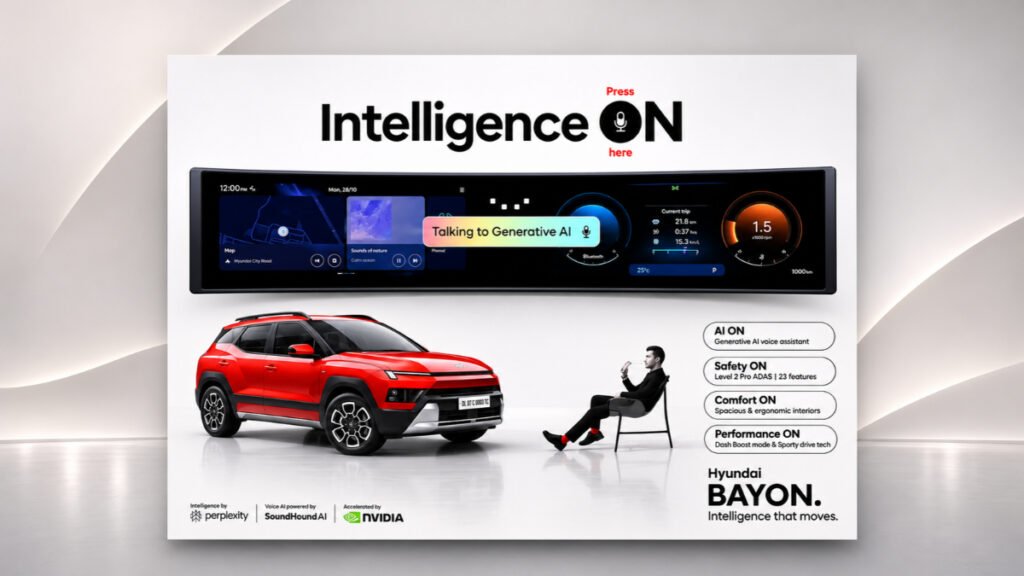
A newspaper advertisement is traditionally something readers see. Hyundai is challenging that convention with a campaign that combines print and audio to bring the features of its BAYON vehicle to life. The campaign, created through Havas Media India and Innocean, transforms a four-page Hindustan Times newspaper execution into an interactive, audio-enabled brand experience across Delhi and Mumbai.
A Newspaper That Talks Back
The campaign uses a four-page advertisement in the Hindustan Times to introduce the Hyundai BAYON under the proposition “Intelligence That Moves”. Its central idea, “Intelligence ON”, connects the vehicle’s technology-led positioning with an unexpected feature in the newspaper: audio engagement.
Rather than relying entirely on written product descriptions and photographs, the execution invites readers to listen to the advertisement. This creates a more direct connection between the medium and the product being promoted.
The campaign was rolled out across Delhi and Mumbai, with Havas Media India and Innocean working together on the media innovation.
Four Pillars of Product Storytelling
The campaign highlights four areas of the BAYON’s proposition: AI and connectivity, safety, performance and comfort.
The AI and connectivity element features the vehicle’s in-built generative AI voice assistant and connected technology. The safety communication focuses on structural engineering, advanced safety features and intelligent driver assistance.
Performance is presented through technologies including Dash Boost Mode and Sports Drive Tech, while the comfort proposition highlights intelligent space utilisation, premium interiors and features designed around occupants.
By organising the communication around these four pillars, the campaign attempts to make a complex product story easier to explore through a single media execution.
Why Audio Makes the Difference
Audio adds another dimension to print advertising. A newspaper traditionally depends on visual attention and written information, but sound can make a campaign feel more immediate and participatory.
For Hyundai, the approach also creates a connection between the advertisement and the vehicle’s voice-assistant proposition. Readers are not simply being told that the car offers intelligent voice technology; they are introduced to the idea through an audio-led experience.
This is an example of product demonstration becoming part of the advertising format itself.
Print Advertising Gets an Interactive Twist
The campaign highlights an opportunity for traditional media in an increasingly digital advertising environment.
Newspapers continue to offer a physical reading experience, but brands must find creative ways to earn attention when audiences are surrounded by digital content. Interactive formats can give readers a reason to pause, engage and spend more time with an advertisement.
Combining print with audio also demonstrates how media agencies can rethink established formats instead of treating them as static placements.
However, the effectiveness of such campaigns will depend on participation, ease of use and whether the experience communicates a meaningful product benefit. Innovation needs to create value for the audience, not simply novelty.
A New Direction for Brand Experiences
The campaign reflects a broader shift in advertising towards experiences that allow consumers to interact with brand messages.
For Havas Media India and Innocean, the Hyundai BAYON execution demonstrates how media planning and creative thinking can work together to turn an ordinary newspaper placement into a product-led experience.
For advertisers, the lesson is relevant beyond the automobile category. Print, outdoor, audio and digital media can become more engaging when brands consider what audiences can do with an advertisement, rather than only what they can see.
The bigger takeaway: The future of print advertising may not depend on competing with digital media on digital media’s terms. It may lie in combining the physical strengths of print with interactive experiences that make readers stop, listen and participate.
Campaign partners: Havas Media India and Innocean
Brand: Hyundai BAYON
Media platform: Hindustan Times
Markets: Delhi and Mumbai
Reference: Campaign details – Manifest Media