
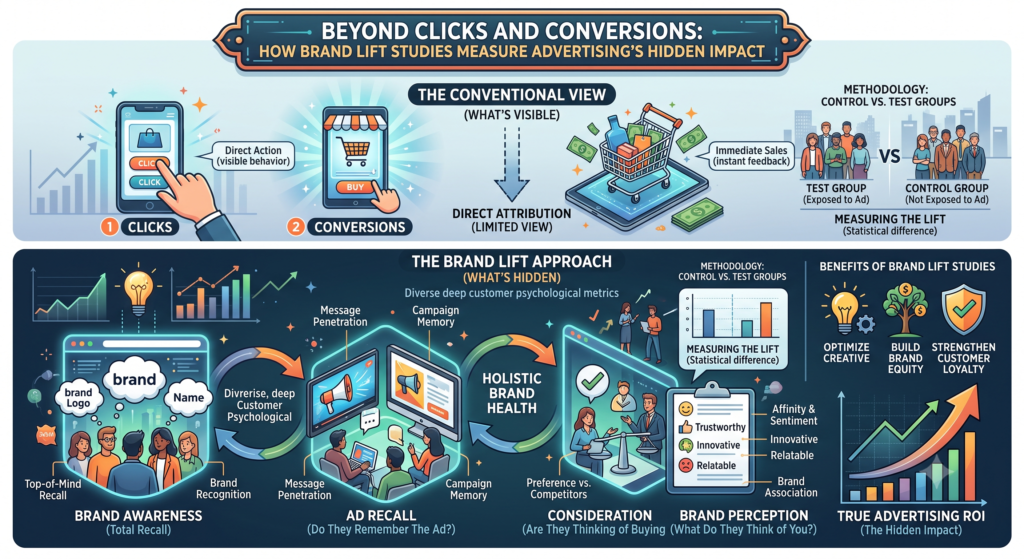
For years, digital advertising has trained marketers to focus on measurable actions: clicks, app installs, leads, purchases, and conversions. But not every advertisement is designed to generate an immediate transaction. Some campaigns are intended to make consumers recognize a brand, remember a message, or consider a product when they are ready to buy.
That is where brand lift studies come in.
What Is Brand Lift?
Brand lift measures changes in consumer attitudes or awareness after exposure to an advertising campaign.
Instead of asking only whether someone clicked an advertisement, a brand lift study can examine whether advertising changed metrics such as brand awareness, ad recall, consideration, favorability, or purchase intent.
The central question is simple: Did the advertising change what consumers think or know about the brand?
Why Performance Metrics Aren’t Enough
Performance marketing is designed around measurable actions. If an advertisement generates 10,000 clicks or 500 purchases, marketers can directly track those outcomes.
Brand-building campaigns work differently.
A consumer might see an advertisement several times without clicking it. Weeks later, that consumer may remember the brand while shopping and eventually make a purchase offline.
A last-click measurement system may not credit the original advertisement for that outcome.
Brand lift studies attempt to capture some of this less visible impact.
The Control Group Matters
A typical brand lift study compares people who were exposed to an advertising campaign with a similar group that was not exposed.
Consumers in both groups can be asked questions about the brand. The difference between their responses is used to estimate the campaign’s impact.
For example, if 40% of the exposed group recognizes a brand compared with 32% of the control group, the measured lift would be eight percentage points.
The comparison is important because awareness can change for reasons unrelated to advertising, including news coverage, competitor activity, seasonality, or broader market trends.
What Gets Measured?
Different studies can measure different stages of the consumer journey.
Awareness examines whether consumers know or recognize the brand.
Ad recall asks whether consumers remember seeing the advertising.
Consideration measures whether consumers would consider the brand when making a purchase.
Favorability examines consumer attitudes toward the brand.
Purchase intent looks at whether consumers say they are likely to buy the product.
Some studies can also examine message association, brand attributes, or category perceptions.
India’s Complex Consumer Market
Brand lift measurement can be particularly relevant in India because advertising operates across a highly fragmented media environment.
A campaign may run simultaneously on television, streaming platforms, social media, online video, connected TV, outdoor media, and other channels.
Consumers can also encounter the same brand through multiple touchpoints.
This makes it difficult to understand the contribution of a single advertisement using conversion data alone.
Digital Platforms Enter the Picture
Major digital advertising platforms have developed their own forms of brand lift measurement.
These studies can allow advertisers to compare exposed and control audiences within particular advertising environments.
However, results from one platform should not automatically be treated as a universal measurement of the entire campaign. Each study can differ in methodology, audience, sample size, questionnaire design, and campaign environment.
Brand Lift vs. Sales Lift
The two concepts are related but different.
A brand lift study measures changes in attitudes, awareness, or perceptions.
A sales lift study attempts to measure changes in purchasing behavior or sales associated with advertising exposure.
A campaign can generate strong brand lift without producing immediate sales movement, particularly when consumers have a long purchase cycle.
Conversely, a performance campaign can produce conversions without substantially changing broader brand perceptions.
The Role of Surveys
Consumer surveys remain an important component of many brand lift studies.
Participants may be asked questions before or after exposure, or exposed and control groups may be compared after a campaign.
The quality of the results depends heavily on research design. Poor sampling, leading questions, insufficient sample sizes, or differences between exposed and control groups can affect the findings.
Why CMOs Care
For chief marketing officers, brand lift provides another way to evaluate advertising that cannot be fully explained through clicks and conversions.
It can help answer questions such as whether a campaign improved awareness, whether the creative communicated the intended message, and whether media exposure changed consumer consideration.
That information can influence future creative and media decisions.
The Measurement Gap
Modern advertising increasingly requires multiple measurement approaches rather than one universal metric.
Performance marketing can tell marketers what happened at the conversion level. Brand lift can provide evidence about changes in consumer perceptions and awareness.
Neither approach tells the entire story on its own.
As Indian brands compete across increasingly crowded categories and fragmented media channels, understanding both immediate response and longer-term brand impact is becoming an increasingly important part of marketing measurement.
The result is a broader definition of advertising effectiveness, one that looks beyond the click to ask whether an advertisement actually changed the way consumers see a brand.