
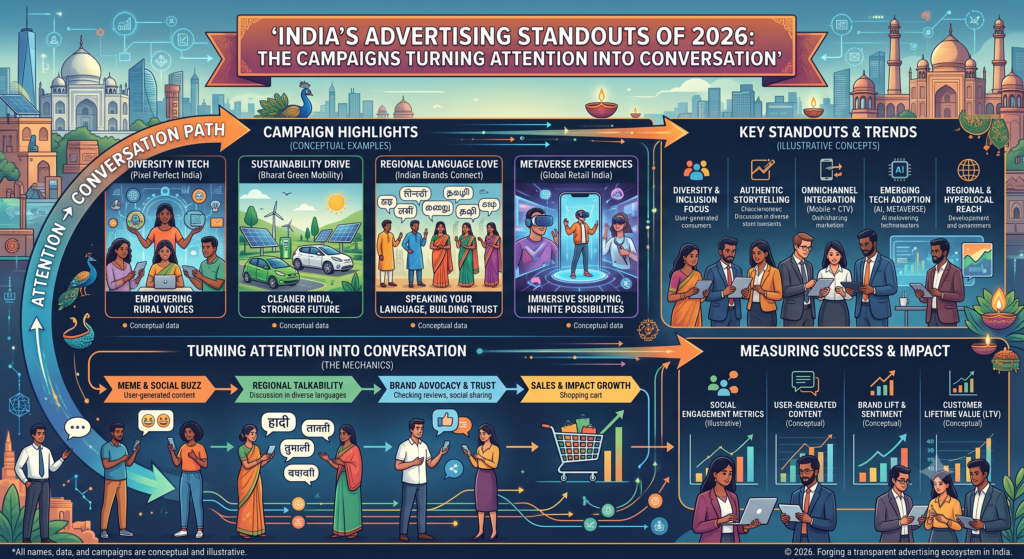
India’s advertising industry has produced a steady stream of campaigns in 2026, with brands experimenting with humour, nostalgia, cultural storytelling, creators, artificial intelligence and new digital formats. Rather than relying only on conventional television commercials, marketers are increasingly building campaigns that extend across social media, short-form video, microdramas and experiential platforms.
This monthly tracker looks at campaigns that have generated notable industry attention during 2026. It is a curated editorial selection, not a formal ranking or award list.
January To March: Storytelling Takes Centre Stage
The early months of 2026 reflected a continuing shift towards advertising built around recognisable human situations rather than straightforward product demonstrations.
Brands increasingly looked for stories that could travel across platforms, allowing a television film to become social content, creator material or a longer digital property.
The approach also reflected a broader industry trend: consumers are increasingly exposed to advertisements while simultaneously consuming entertainment, news and creator content.
April To June: Digital Gets More Ambitious
By the middle of the year, digital campaigns were becoming more elaborate.
Brands experimented with interactive formats, creator partnerships and campaigns designed specifically for online communities. Sports, particularly cricket, continued to provide advertisers with opportunities to combine mass reach with real-time digital conversations.
At the 2026 DigiPlus Awards, campaigns including Kingfisher’s IPL activation and Hero MotoCorp’s Destini campaign received Gold recognition in the Digital Campaign of the Year category, highlighting the growing importance of campaigns that connect creative storytelling with digital engagement.
July To August: Culture And Context
The second half of the year saw advertisers increasingly use Indian cultural references and everyday experiences as creative material.
This approach has also been reflected in Kantar’s 2026 Creative Effectiveness Awards India, which evaluated more than 250 advertisements. Kantar highlighted cultural relevance, human truths and natural brand integration as common characteristics of campaigns that performed strongly with consumers.
Among the campaigns recognised were Taj Mahal’s “Pehle Aap,” Tata Salt’s “Vidaai” and Medimix’s “Nakhrewali to Nikharwali Skin.”
September: Microdramas Go Mainstream
September has brought another notable development: brands are increasingly turning advertising into episodic entertainment.
Nykaa and SW Network launched “Hotel Wanderlust,” a six-part Instagram microdrama integrating the brand’s bath and body products into a fictional hotel setting. JK Cement has also built a 53-episode microdrama property around its brand story.
The format represents a broader attempt to keep audiences engaged for longer than a conventional advertisement.
Nostalgia Finds A New Audience
Nostalgia has remained another important creative tool.
A recent milk campaign featuring Vijay Sethupathi uses a father-daughter story and childhood memories to explore changing family habits. Campaign India reported the film as part of a wider trend toward emotionally driven storytelling.
Such campaigns demonstrate how familiar experiences can become a way of communicating a product proposition without relying exclusively on conventional sales messaging.
AI Enters The Creative Workflow
Artificial intelligence is also becoming part of the Indian advertising landscape.
Campaigns are increasingly using AI in production, personalisation, research and content development. One recent example is Liqvd Asia’s campaign for Amplifon, an AI-produced Father’s Day film adapted into six languages. The campaign reportedly generated more than 2.2 million views and won Gold at the DATAMATIX Asia Awards 2026.
At the same time, new advertising technology platforms are emerging specifically to help brands plan and measure campaigns across AI-powered environments.
September’s Creative Rush
The current month has produced a particularly wide range of campaigns.
Philips launched “Airfryer matlab Philips” with Sushmita Sen and Chef Ranveer Brar. CP Plus used its cricket partnership to build around the line “Upar wala sab dekh raha hai.” ixigo introduced its AI assistant TARA through a campaign encouraging travellers to move beyond herd behaviour.
Other notable launches include Spotify’s music-led campaign around everyday chores, Vi’s Shah Rukh Khan-led brand campaign and Mercedes-Benz’s film centred on Indian roads and journeys.
What Makes 2026 Different
The most visible shift is not a single creative style but the increasing number of formats brands are using.
Traditional TVCs now sit alongside creator campaigns, Instagram microdramas, AI-generated films, interactive activations and commerce-linked content.
The boundary between advertising and entertainment is becoming increasingly fluid.
The Monthly Tracker
As 2026 progresses, the Indian advertising conversation is moving beyond the question of which advertisement received the most views.
Marketers are examining whether campaigns can generate attention, create cultural relevance, communicate a clear brand role and continue the conversation across multiple platforms.
That makes this year’s advertising landscape less about one dominant formula and more about experimentation.
From culturally rooted storytelling and nostalgia to microdramas, creator-led campaigns and AI-assisted production, Indian brands are using an increasingly broad creative toolkit to compete for consumer attention.
The rest of 2026 is likely to add another layer to that experimentation—making the monthly advertising tracker as much a record of changing consumer behaviour as it is a record of changing advertising styles.