
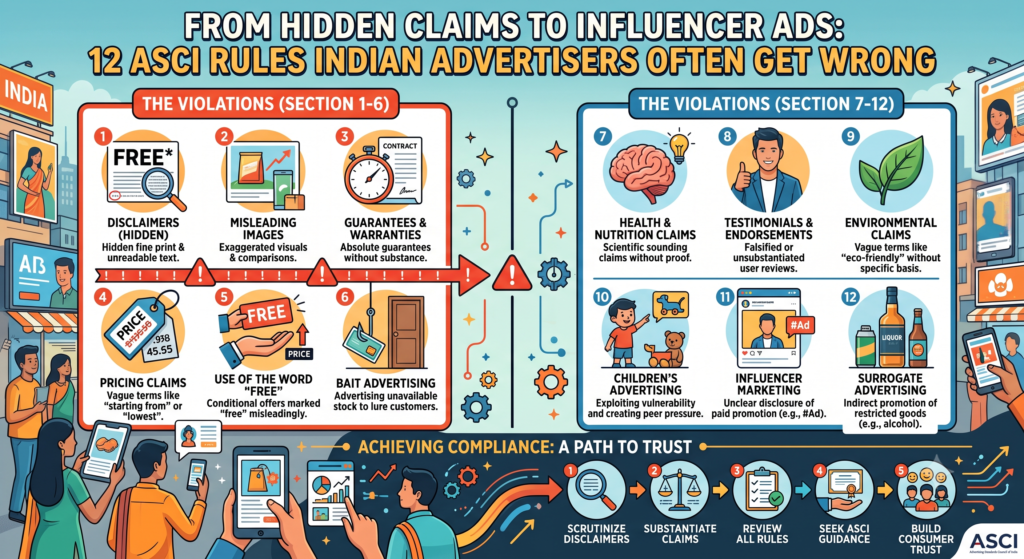
India’s advertising industry operates under a detailed framework designed to ensure that marketing communication is truthful, responsible and fair. At the centre of this system is the Advertising Standards Council of India (ASCI), a voluntary self-regulatory body established in 1985.
The ASCI Code applies across traditional and digital advertising, covering advertisers, agencies and media. Its core principles require advertisements to be legal, decent, honest and truthful while avoiding harmful or misleading communication.
1. Making Claims Without Proof
An advertisement cannot simply make an objective claim because it sounds convincing. Claims relating to measurable facts must be capable of substantiation.
Statements about performance, effectiveness, savings or product superiority therefore need appropriate evidence when challenged.
2. Hiding Important Information
An advertisement can be misleading even when every individual statement is technically accurate.
The ASCI Code addresses misleading consumers through implications, omissions, ambiguity or exaggeration. Leaving out information that materially changes how a consumer understands an offer can therefore create a compliance problem.
3. Exaggerating Product Benefits
Marketing naturally involves persuasive language, but exaggerated claims cannot create unrealistic expectations.
The Code restricts claims so exaggerated that they could result in serious or widespread consumer disappointment. Humorous or obvious hyperbole can be acceptable when consumers would not reasonably interpret it as a literal product claim.
4. Calling Something “Free”
The word “free” comes with specific expectations.
If consumers have to pay a direct cost beyond permitted delivery, freight or postage charges, an offer should not be presented as completely free. Promotional offers also need to make their important conditions clear.
5. Misusing Research Claims
Advertisers sometimes strengthen a message by saying it is “scientifically proven”, “research-backed” or based on independent studies.
Where an advertising claim is expressly presented as being supported by independent research or assessment, advertisers need to be able to substantiate the claim and provide appropriate details about the supporting evidence.
6. Disguising Paid Content
The growth of influencer marketing has made the distinction between advertising and organic content increasingly important.
Influencers with a material connection to an advertiser must use an appropriate disclosure. That connection can involve money, free products, discounts, trips, gifts or other benefits.
The disclosure should be easy for consumers to notice rather than hidden in a profile or buried deep within a caption.
7. Using Misleading Filters
Digital advertising can alter how products appear.
The ASCI’s influencer guidelines caution against using filters that mislead consumers about product benefits—for example, making hair appear shinier or teeth appear whiter than the product can realistically achieve.
8. Creating False Urgency
Messages such as “only a few left” or “offer ending soon” can influence consumers to act quickly.
But if the limitation is not genuine, the advertisement can be considered misleading. Advertisers should be able to substantiate claims about scarcity, limited availability or time-sensitive offers.
9. Using Bait-and-Switch Tactics
An advertisement should not promise one outcome and then provide consumers with something materially different.
Examples include displaying an attractive price while making the advertised product unavailable when consumers attempt to purchase it, then directing them toward a more expensive alternative.
10. Forgetting Children Need Extra Protection
Advertising directed at children faces additional safeguards.
The ASCI Code prohibits advertisements from exploiting children’s vulnerability or encouraging dangerous behaviour. It also places restrictions on certain depictions involving hazardous activities and products.
11. Crossing Into Harmful or Offensive Content
Advertisements cannot promote violence, criminal behaviour or intolerance, and they should not unfairly ridicule individuals or groups on specified grounds.
The Code also requires advertising to avoid content likely to cause serious or widespread offence under prevailing standards of public decency.
12. Using Surrogate Advertising
Advertisers cannot simply use another product or service to circumvent restrictions on advertising a prohibited or restricted category.
When assessing potential indirect advertising, regulators and self-regulatory bodies can consider whether the alternative product genuinely exists and whether the advertisement contains clues or cues pointing toward the restricted product.
The Rules Are Evolving
The ASCI framework continues to evolve alongside digital advertising. As social media, influencer campaigns and new forms of online promotion expand, the boundaries between advertising, entertainment and organic content are becoming increasingly important.
For advertisers, the broader lesson is that compliance is no longer limited to avoiding obviously false statements. Pricing, disclosures, visual presentation, influencer relationships, research claims and even the way an offer is framed can determine whether an advertisement meets India’s advertising standards.
As advertising shifts increasingly toward influencers, social platforms and data-driven campaigns, understanding the ASCI Code is becoming an important part of the creative process itself.