
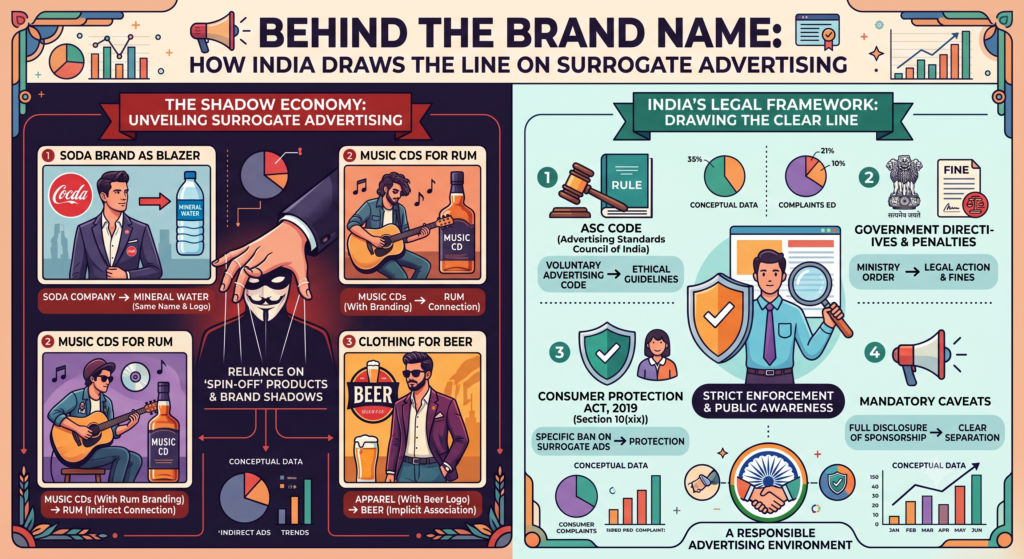
Surrogate advertising has long occupied a complicated space in India’s marketing industry. When direct promotion of certain products is restricted or prohibited, companies may promote another product carrying a similar brand identity. The practice has made brand extensions such as music, merchandise, water or other consumer products a recurring subject of regulatory scrutiny.
India’s advertising rules increasingly focus not only on what an advertisement explicitly says but also on whether its overall presentation indirectly promotes a restricted product.
What Is Surrogate Advertising?
Surrogate advertising generally refers to an advertisement that appears to promote a permitted product or service but effectively promotes a different product whose advertising is prohibited or restricted.
Indian consumer-protection rules prohibit surrogate or indirect advertising when it is used to circumvent an existing legal restriction. The rules can also consider the use of a restricted product’s brand name, logo, colours, layout or presentation when determining whether an advertisement amounts to indirect promotion.
Why It Became A Problem
The issue has been particularly prominent in categories such as alcohol and tobacco, where direct advertising faces significant restrictions.
A company may have a brand associated with a restricted product and also sell other legitimate products under the same or a related identity. Advertising the legitimate product can therefore raise questions about whether consumers are actually being reminded of the restricted product.
Regulators distinguish between genuine brand extensions and attempts to use an apparently permitted product as a vehicle for indirect promotion.
What TV Rules Say
The advertising rules governing television prohibit advertisements that directly or indirectly promote cigarettes, tobacco products, wine, alcohol, liquor and other intoxicants.
However, advertising of genuine products that share a brand name or logo with restricted products can be permitted under specific conditions. The advertisement must focus on the permitted product and cannot use references or promotional cues associated with the prohibited product.
Brand Extensions Under Scrutiny
This distinction is central to the regulatory framework.
A company may legitimately sell a non-restricted product carrying a brand name also associated with alcohol or tobacco. But simply putting the brand name on another product does not automatically make an advertisement permissible.
Regulators can consider whether the advertised product is genuine and commercially available and whether the advertisement’s presentation effectively promotes the restricted category.
Government authorities have previously issued advisories to broadcasters concerning surrogate advertisements and brand extensions.
It’s Not Just About Alcohol
Although alcohol and tobacco are among the most familiar examples, the broader consumer-protection framework covers advertisements for goods and services whose advertising is restricted or prohibited by law.
The underlying principle is that companies cannot simply rename or repackage a prohibited advertising message and present it as an advertisement for something else.
The regulatory approach has also expanded into newer digital categories, including concerns around surrogate promotions involving restricted or prohibited online services.
Who Can Face Action?
The regulatory system can involve multiple parties across the advertising chain, depending on the applicable law and circumstances.
Advertisers, advertising agencies, broadcasters, publishers, digital platforms and endorsers can all face compliance questions when an advertisement is alleged to violate applicable rules.
Television broadcasters are subject to statutory advertising requirements, while advertising and consumer-protection authorities can examine complaints involving potentially misleading or prohibited promotions.
Where The Line Gets Drawn
The biggest challenge is often distinguishing a legitimate brand-extension campaign from an indirect attempt to advertise a restricted product.
A permitted product must be more than a convenient label. Regulators can examine its actual availability, the advertisement’s visuals and language, the brand presentation and whether the campaign contains cues associated with the prohibited category.
This makes compliance a substantive issue rather than simply a matter of changing the product shown in an advertisement.
The Digital Challenge
Digital platforms have made the issue more complicated. Advertising can now reach consumers through social media, influencers, websites, streaming platforms and other channels that operate differently from traditional television.
As advertising moves across platforms, brands and agencies must consider multiple regulatory frameworks rather than relying solely on traditional television advertising rules.
A Changing Advertising Landscape
India’s approach to surrogate advertising reflects a broader shift in advertising regulation: authorities are increasingly concerned with the actual presentation and potential effect of marketing communications, not merely their stated purpose.
For marketers, the distinction between a legitimate brand extension and an indirect advertisement can therefore be critical.
As brands expand into new categories and increasingly use digital creators and platforms, scrutiny of how restricted-product identities are promoted is likely to remain an important issue for India’s advertising industry.