
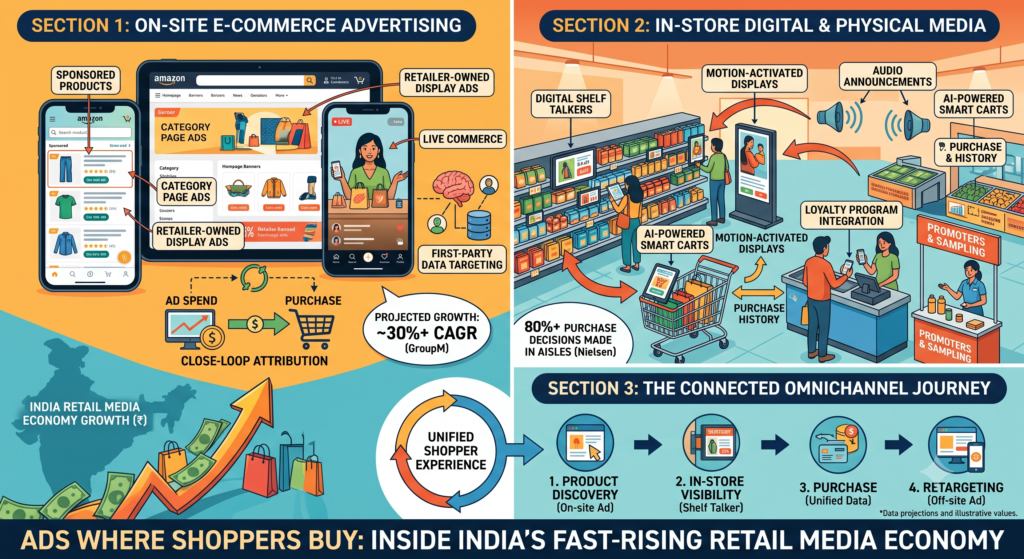
Retail media is rapidly becoming one of the most important parts of India’s digital advertising ecosystem. As millions of consumers move between online marketplaces, quick-commerce apps, food delivery platforms and physical stores, retailers are turning their customer data and digital platforms into advertising businesses.
The model is simple: brands pay retailers to reach consumers at or near the point when they make purchasing decisions.
What Is Retail Media?
Retail media refers to advertising opportunities offered by retailers and commerce platforms using their websites, apps, stores and customer data.
Instead of relying only on traditional advertising platforms such as search engines or social media, brands can advertise directly within an environment where consumers are already shopping.
A customer searching for shampoo on an e-commerce platform, for example, may see sponsored products at the top of the results. A quick-commerce user might see a promoted brand on the app’s home screen. In physical stores, digital screens, displays and promotional placements can also form part of a retail media network.
Why India Is Seeing Rapid Growth
India’s retail market has undergone a major digital transformation. E-commerce, smartphones, digital payments and quick commerce have brought more shopping activity online and created enormous amounts of consumer and transaction data.
Retailers now know what consumers search for, what they purchase, how frequently they shop and, in many cases, which categories they are interested in.
This information makes retail media particularly attractive to advertisers because campaigns can be connected more directly to shopping behaviour.
From Advertising to Sales
One of retail media’s biggest attractions is its proximity to the transaction.
Traditional advertising can create awareness, but measuring whether an advertisement ultimately resulted in a purchase can be difficult. Retail media platforms, by contrast, can often connect an advertisement with product views, clicks and purchases within the same ecosystem.
This gives marketers a clearer way to evaluate campaign performance.
For consumer brands, the ability to reach shoppers when they are already considering a purchase can be particularly valuable.
E-Commerce Leads the Market
Large online marketplaces were among the earliest adopters of retail media in India.
Sponsored product listings, banner placements, search advertising and promotional campaigns allow sellers and consumer brands to compete for visibility within shopping platforms.
The business opportunity extends beyond marketplaces. Food-delivery companies, quick-commerce platforms, fashion retailers, grocery chains and other consumer-facing businesses are increasingly exploring advertising as an additional revenue stream.
Quick Commerce Changes the Game
The rapid expansion of quick commerce has added another dimension to India’s retail media market.
Platforms built around rapid delivery have frequent interactions with consumers and operate across categories ranging from groceries and beverages to personal care and household products.
Because consumers often use these apps for immediate purchases, brands can promote products directly at the moment of demand.
The short purchase journey also gives platforms valuable information about consumer behaviour.
The Data Advantage
Data is at the centre of the retail media opportunity.
Retailers can use first-party information generated through their own platforms to understand consumer segments and shopping patterns. For advertisers, this can provide more targeted opportunities than broad demographic advertising.
However, the growing importance of consumer data also puts greater emphasis on privacy, consent and responsible data practices.
Retail media networks need to balance commercial opportunities with applicable data protection and advertising requirements.
More Than Digital Ads
Retail media is not limited to advertisements inside mobile applications.
Large retailers can combine digital and physical advertising inventory. In-store screens, shelf displays, checkout promotions, loyalty programmes and branded experiences can all become part of a broader retail media network.
This creates an opportunity for brands to connect online discovery with offline purchases.
A New Revenue Stream
For retailers, advertising can become an additional source of high-margin revenue alongside product sales, delivery fees and other services.
That is one reason the sector is attracting increasing attention. Retailers already have consumer traffic, purchasing data and multiple points of interaction. Turning those assets into advertising inventory allows them to monetise their existing ecosystems in another way.
What Comes Next
India’s retail media market is still developing, but its expansion reflects a broader shift in advertising: brands increasingly want measurable connections between marketing expenditure and consumer purchases.
As e-commerce, quick commerce and organised retail continue to expand, more companies are likely to build retail media networks.
The next phase could see greater integration between advertising, commerce, loyalty programmes and consumer analytics. For brands, that means more opportunities to reach shoppers closer to the point of purchase. For retailers, it could turn the shopping platform itself into a significant advertising business.
Retail media, therefore, is not simply another digital advertising format. It represents a convergence of commerce, consumer data and marketing, and India’s rapidly evolving retail landscape is creating the conditions for that convergence to grow.